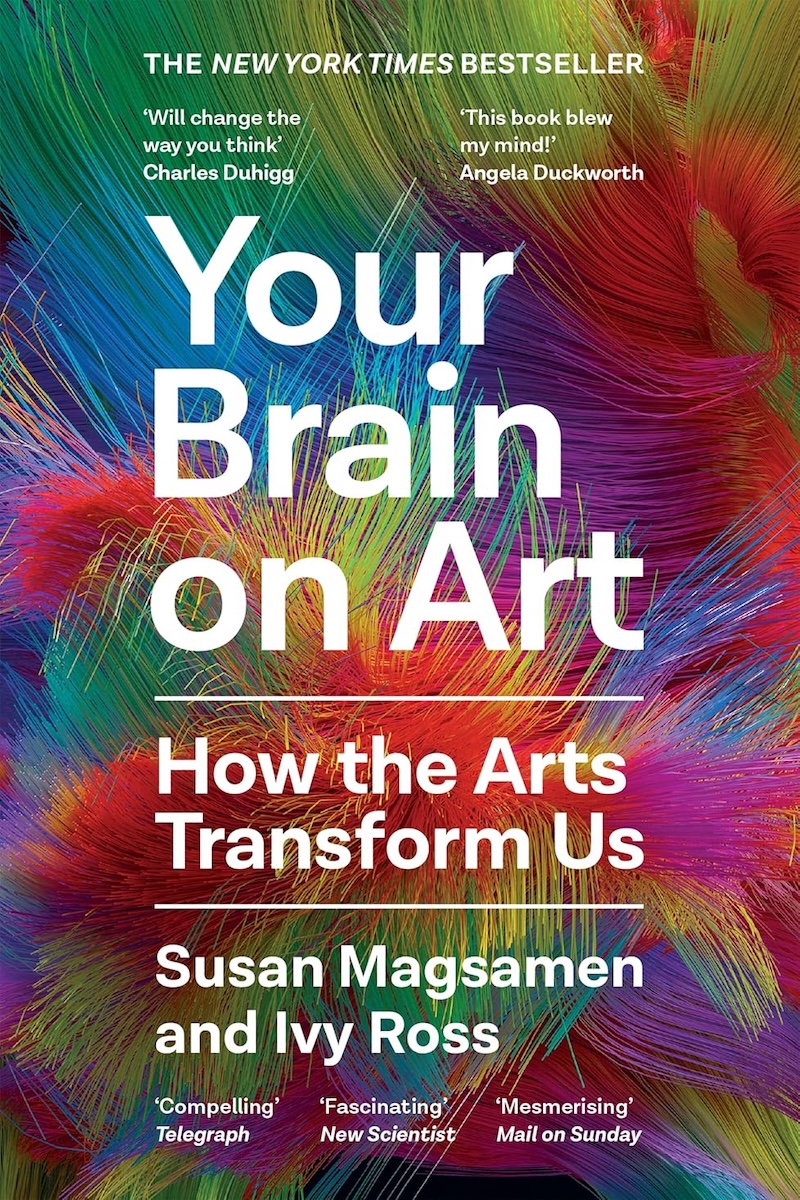
01 / Classic Textbook Recommendation
Classic Textbook Recommendation
Part 1. Citation, Context, Thesis & Key Concepts
Citation
Magsamen, S., & Ross, I. (2023). Your brain on art: How the arts transform us. Random House.
Author & Publication Information
- Susan Magsamen: Founder and executive director of the International Arts + Mind Lab at Johns Hopkins University School of Medicine. She developed the Impact Thinking Model and co-directs the NeuroArts Blueprint with the Aspen Institute oai_citation:0‡Susan Magsamen,Ivy Ross - Your brain on art how the arts transform us (2023) - libgen.li.pdf.
- Ivy Ross: Vice President of Hardware Design at Google, responsible for award-winning product aesthetics. She has held senior creative positions at Calvin Klein, Swatch, Coach, and Mattel oai_citation:1‡Susan Magsamen,Ivy Ross - Your brain on art how the arts transform us (2023) - libgen.li.pdf.
- Publication: Released in 2023, the book sits at the intersection of neuroscience, psychology, and aesthetics.
Intellectual & Historical Context
- Emerges from the Neuroaesthetics movement, which investigates how art engages neural processes.
- Builds on decades of research showing that creative practices impact mental health, stress reduction, and social connection.
- Arrives at a cultural moment emphasizing integrative health and well-being, with growing institutional recognition (e.g., WHO’s interest in arts and health).
Thesis Statement
The authors argue that the arts are not ornamental but essential to human survival and flourishing. Engaging with art—through music, dance, painting, storytelling, or digital media—alters neurochemistry, reshapes brain networks, supports healing, and strengthens social bonds.
Key Concepts
- Neuroplasticity: The brain rewires itself in response to artistic engagement oai_citation:2‡Susan Magsamen,Ivy Ross - Your brain on art how the arts transform us (2023) - libgen.li.pdf.
- Aesthetic Triad: Cognitive, sensory-motor, and emotional systems jointly mediate aesthetic experience oai_citation:3‡Susan Magsamen,Ivy Ross - Your brain on art how the arts transform us (2023) - libgen.li.pdf.
- Default Mode Network (DMN): Art engages the DMN, influencing self-reflection and memory oai_citation:4‡Susan Magsamen,Ivy Ross - Your brain on art how the arts transform us (2023) - libgen.li.pdf.
- Social Brain: Art activates neural circuits for empathy, bonding, and collective meaning-making oai_citation:5‡Susan Magsamen,Ivy Ross - Your brain on art how the arts transform us (2023) - libgen.li.pdf.
- Neurochemical Effects: Arts trigger endorphins, dopamine, oxytocin—biological bases for catharsis and connection oai_citation:6‡Susan Magsamen,Ivy Ross - Your brain on art how the arts transform us (2023) - libgen.li.pdf.
- Impact Thinking Model: A framework for applying arts to health, learning, and community change.
Part 2. Chapter Summaries
Introduction & Foundations
- Presents the emerging field of Neuroarts. Positions art as fundamental to cognition, akin to language or sociality.
Chs. 1–3: Brain and Aesthetics
- Explains basic brain anatomy (frontal, parietal, temporal, occipital lobes; limbic system) oai_citation:7‡Susan Magsamen,Ivy Ross - Your brain on art how the arts transform us (2023) - libgen.li.pdf.
- Introduces four core concepts: neuroplasticity, aesthetic triad, biological synchrony, default mode network.
Chs. 4–7: Healing and Health
- Arts interventions reduce toxic stress, support trauma recovery, and foster resilience oai_citation:8‡Susan Magsamen,Ivy Ross - Your brain on art how the arts transform us (2023) - libgen.li.pdf.
- Studies show knitting, clay sculpting, doodling, and expressive writing activate healing pathways oai_citation:9‡Susan Magsamen,Ivy Ross - Your brain on art how the arts transform us (2023) - libgen.li.pdf.
Chs. 8–11: Learning and Development
- Youth arts programs (e.g., Youth Orchestra LA) strengthen executive function and empathy oai_citation:10‡Susan Magsamen,Ivy Ross - Your brain on art how the arts transform us (2023) - libgen.li.pdf.
- Arts improve memory, attention, and creativity by building neural networks oai_citation:11‡Susan Magsamen,Ivy Ross - Your brain on art how the arts transform us (2023) - libgen.li.pdf.
Chs. 12–15: Social Connection & Society
- Arts engage the social brain connectome, showing how collective experiences (dance, music, theatre) reinforce belonging oai_citation:12‡Susan Magsamen,Ivy Ross - Your brain on art how the arts transform us (2023) - libgen.li.pdf.
- Shared rhythms and movement foster empathy and prosocial behavior oai_citation:13‡Susan Magsamen,Ivy Ross - Your brain on art how the arts transform us (2023) - libgen.li.pdf.
Chs. 16–19: Technology & Future of Neuroarts
- Examines VR, smart textiles, and immersive environments as future platforms for healing and creativity oai_citation:14‡Susan Magsamen,Ivy Ross - Your brain on art how the arts transform us (2023) - libgen.li.pdf.
- Argues that the arts, combined with neuroscience and digital innovation, will shape healthcare, education, and civic life.
Conclusion
- Calls for a cultural paradigm shift: arts should be integrated into medicine, education, and public health policy.
Part 3. Key Quotes & Significance
Key Quotes
- “The arts trigger the release of neurochemicals, hormones, and endorphins that offer you an emotional release.” oai_citation:15‡Susan Magsamen,Ivy Ross - Your brain on art how the arts transform us (2023) - libgen.li.pdf
- “Art essentially engages the social brain.” oai_citation:16‡Susan Magsamen,Ivy Ross - Your brain on art how the arts transform us (2023) - libgen.li.pdf
- “Your responses to the arts and aesthetics are as individual as the geometry of a snowflake.” oai_citation:17‡Susan Magsamen,Ivy Ross - Your brain on art how the arts transform us (2023) - libgen.li.pdf
- “Art potentially constitutes a novel and powerful tool to understand, diagnose, and treat disorders of the socio-emotional brain.” oai_citation:18‡Susan Magsamen,Ivy Ross - Your brain on art how the arts transform us (2023) - libgen.li.pdf
- “Becoming aware of what you like and don’t like…creates opportunities for you to apply your perceptual preferences to almost every area of your life.” oai_citation:19‡Susan Magsamen,Ivy Ross - Your brain on art how the arts transform us (2023) - libgen.li.pdf
Significance & Impact
- Medicine & Public Health: Supports integration of arts therapies into clinical practice for stress, trauma, and neurodegenerative conditions.
- Education: Validates arts education as crucial for cognitive and socio-emotional development.
- Neuroscience: Advances understanding of how aesthetic experiences engage multiple neural systems simultaneously.
- Policy & Society: Aligns with WHO and global movements recognizing arts as determinants of health.
- Cultural Impact: Positions art as a biological necessity, reframing creativity from luxury to essential human function.
Broader Implications
- Encourages a shift from “arts as entertainment” to “arts as essential infrastructure.”
- Promotes cross-sector partnerships between healthcare, technology, and creative industries.
- Highlights personalization of artistic engagement—unique neural fingerprints mean art is deeply individual yet universally necessary.