01 / Classic Textbook Recommendation
Classic Textbook Recommendation
Citation
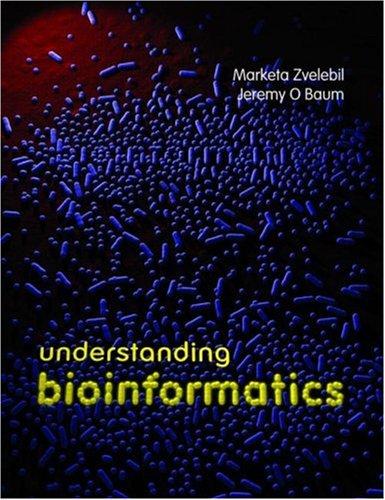
Zvelebil, M. J., & Baum, J. O. (2007). Understanding Bioinformatics. Garland Science.
Why It Matters
Modern biology produces more sequence and structural data than can be interpreted by reading one result at a time. Bioinformatics supplies the concepts and computational habits needed to turn that data into biological questions and testable hypotheses.
Core Ideas
Biological Questions First
An algorithm is useful only when its output answers a well-defined biological question. The book keeps sequence comparison, gene finding, structure, and networks connected to experimental meaning.
Similarity and Evolution
Alignment and database searches use similarity to infer possible homology, function, or evolutionary history. Those inferences depend on scoring choices and carefully selected reference data.
Models and Uncertainty
Probabilistic models can represent noisy observations and incomplete knowledge. A result is not a fact merely because software produced a number; assumptions and validation matter.
Reproducible Analysis
Data formats, parameters, annotations, and scripts all affect a computational result. Good bioinformatics therefore includes documentation, versioning, and critical evaluation of databases.
Reading Lens
For each method, write down the input, the transformation, the output, and the biological claim it supports. Compare a method that finds patterns with one that tests a mechanistic hypothesis.
Conclusion
Understanding Bioinformatics helps biology students become careful users of computation. Its enduring lesson is that biological interpretation and algorithmic reasoning must be developed together.