01 / Classic Textbook Recommendation
Classic Textbook Recommendation
Citation
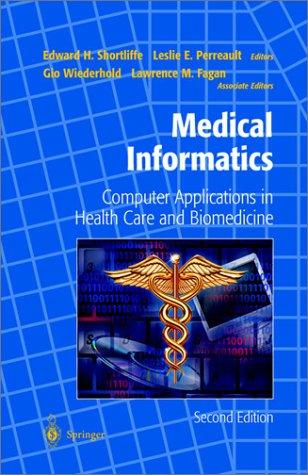
Shortliffe, E. H., Perreault, L. E., Wiederhold, G., & Fagan, L. M. (Eds.). (2003). Medical Informatics: Computer Applications in Health Care and Biomedicine (2nd ed.). Springer.
Why It Matters
Health care computing is not only a software problem. Data are collected in clinical settings, interpreted by professionals, shared across institutions, and used in decisions that affect patients. Medical informatics studies the whole sociotechnical system.
Core Ideas
Clinical Data
Records contain observations, measurements, narratives, codes, and images. Each representation makes some questions easier while introducing limits and ambiguity.
Decision Support
Computer systems can help clinicians retrieve knowledge, detect patterns, or follow protocols. Their usefulness depends on timing, workflow, transparency, and the quality of the underlying evidence.
Interoperability
Health information becomes more useful when different systems can exchange and interpret it consistently. Standards are technical tools, but they also encode assumptions about clinical work.
People and Institutions
A technically correct system can fail when it increases workload or conflicts with professional practice. Design therefore includes usability, privacy, governance, and organizational change.
Reading Lens
Separate the data model, the computational method, the clinical task, and the institutional setting. Ask what the system helps a person do and what new risks or blind spots it creates.
Conclusion
Medical Informatics is a bridge between biomedical engineering, computer science, and health care. It teaches readers to evaluate clinical technologies as systems embedded in real work rather than isolated tools.