01 / Classic Textbook Recommendation
Classic Textbook Recommendation
Citation
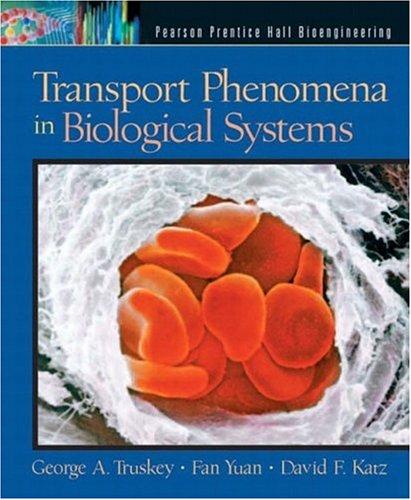
Truskey, G. A., Yuan, F., & Katz, D. F. (2003). Transport Phenomena in Biological Systems. Prentice Hall.
Why It Matters
Many biomedical questions are transport questions: how oxygen reaches tissue, how molecules cross a membrane, or how fluid moves through a vessel. This book gives those questions a common mathematical language without separating engineering models from biological context.
Core Ideas
Conservation Laws
Mass, momentum, and energy balances provide the starting point for describing biological transport. The same principles can be adapted to vessels, tissues, membranes, and engineered devices.
Diffusion and Reaction
Concentration gradients drive molecular transport, while reaction and consumption change the amount available to move. Together they explain problems such as nutrient delivery and drug distribution.
Flow in Biological Geometry
The geometry and scale of a biological system affect resistance, mixing, and shear. Simplified models make it possible to reason about complex structures without losing the governing mechanisms.
Coupled Phenomena
Electrokinetic and interfacial effects show that biological transport is often coupled: electrical fields, surface charge, fluid motion, and chemical gradients can influence one another.
Reading Lens
Translate each biological example into a diagram of sources, sinks, boundaries, and fluxes before doing the mathematics. Pay attention to assumptions such as steady state, negligible inertia, or idealized geometry.
Conclusion
Transport Phenomena in Biological Systems is a strong bridge text for readers moving between engineering and the life sciences. It is most valuable when equations are used to clarify a biological mechanism rather than treated as an end in themselves.