01 / Classic Textbook Recommendation
Classic Textbook Recommendation
Citation
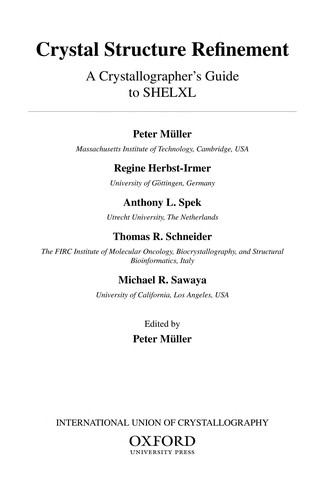
Müller, P. (2006). Crystal Structure Refinement. Oxford University Press.
Why It Matters
Crystal structure refinement turns diffraction measurements into a defensible model of atomic arrangement. The process is not a matter of making a computer fit the data; it requires chemical judgment, statistical reasoning, and careful checks on what the data can support.
Core Ideas
From Diffraction to Structure
Measured intensities are transformed into information about electron density and atomic positions. Each step adds assumptions that must remain visible.
Least-Squares Refinement
Refinement adjusts model parameters to reduce the difference between observed and calculated data. A good numerical fit is necessary but not sufficient.
Chemical Restraints
Bond lengths, angles, symmetry, and displacement parameters help stabilize a model when observations are incomplete. Restraints should clarify chemistry, not hide problems.
Validation and Uncertainty
Residuals, geometry checks, displacement parameters, and difference maps reveal where a model is strong or weak. Reporting uncertainty is part of the result, not an optional appendix.
Reading Lens
Separate observations from model-dependent quantities. Ask which conclusions are directly supported by diffraction and which depend on chemical knowledge or refinement choices.
Conclusion
Crystal Structure Refinement is a focused guide for readers moving from crystallographic data to chemical interpretation. It develops the habit of treating a structure as a tested model rather than an unquestioned image.