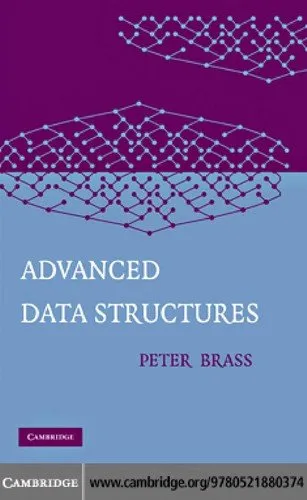
01 / Classic Textbook Recommendation
Classic Textbook Recommendation
Who this book is for
Graduate students and advanced undergraduates who have finished a standard data structures textbook and want to see the full range of known structures and their analysis. It also serves researchers and systems programmers who need to choose or implement a specialised structure, such as an interval tree or a mergeable heap, and want a careful account of its trade-offs.
Prerequisites
An undergraduate data structures and algorithms course, comfort with asymptotic analysis, and working knowledge of C or a similar language.
What it covers
Elementary structures such as stacks and queues; search trees and their operations; balanced search trees, including height-balanced, weight-balanced, red-black, B-trees and splay trees; tree structures for sets of intervals, such as interval, segment and range trees; heaps, including leftist, skew, binomial, Fibonacci and pairing heaps; union-find and related structures; data structures for strings, such as tries, suffix trees and suffix arrays; and hash tables, including universal and perfect hashing.
How to use it
Read selectively by topic, implementing at least one structure from each chapter and testing it against the stated complexity bounds. Use the bibliographic notes to follow ideas back to the original papers when a structure matters for your own project.
Edition and sources
First and only edition, published by Cambridge University Press in hardback in September 2008 (ISBN 9780521880374), with later digital and paperback releases. Bibliographic data for this record comes from the Cambridge Core product page.