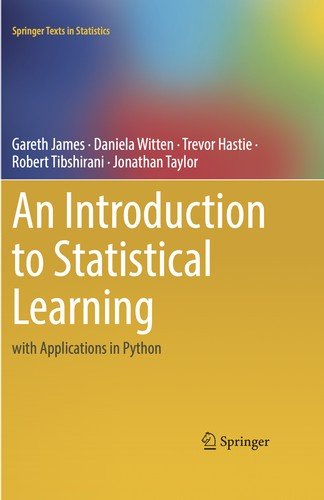
01 / Classic Textbook Recommendation
Classic Textbook Recommendation
Who this book is for
Undergraduates in computer science, statistics, data science, economics and the sciences taking a first course in machine learning, and professionals who want to apply modern predictive methods sensibly. It assumes less mathematics than graduate texts such as The Elements of Statistical Learning by members of the same team, and concentrates on understanding and applying methods.
Prerequisites
An introductory statistics course covering regression and hypothesis testing, plus basic Python; matrix algebra is not required.
What it covers
Statistical learning concepts, the bias-variance trade-off and model assessment; linear regression; classification with logistic regression, discriminant analysis and naive Bayes; resampling with cross-validation and the bootstrap; model selection and regularisation, including ridge regression and the lasso; non-linear methods such as splines and generalised additive models; tree-based methods, random forests and boosting; support vector machines; deep learning; survival analysis; unsupervised learning, including principal components and clustering; and multiple testing.
How to use it
Read the conceptual sections first, then work through the Python lab at the end of each chapter using the accompanying package and datasets. Attempt the applied exercises on your own data. The authors provide a free PDF on the book's website, which makes it easy to try before buying a printed copy.
Edition and sources
First edition of the Python version, published by Springer in 2023 in the Springer Texts in Statistics series (ISBN 9783031387463); earlier R-based editions exist. Bibliographic data for this record comes from Google Books, cross-checked with Open Library.