01 / Classic Textbook Recommendation
Classic Textbook Recommendation
Citation
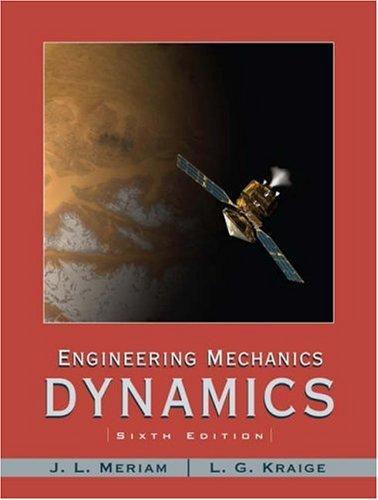
Meriam, J. L., & Kraige, L. G. (2006). Engineering Mechanics: Dynamics (6th ed.). Wiley.
Why It Matters
Dynamics turns motion into a model that can be analyzed. The subject is a foundation for mechanical, aerospace, civil, and biomedical engineering because it explains how forces and geometry combine to produce acceleration and motion.
Core Ideas
Kinematics
Kinematics describes position, velocity, and acceleration without asking what causes the motion. Clear coordinate choices and vector diagrams make this description precise.
Kinetics
Kinetics connects motion to force and mass through equations of motion. Free-body diagrams are the essential bridge between a physical situation and a solvable model.
Energy and Momentum
Work-energy and impulse-momentum methods provide alternatives to direct force balances. They are especially helpful when a problem involves several stages or changing geometry.
Particle and Rigid-Body Models
The choice between a particle and a rigid body determines which motion and rotation must be represented. Good modeling is as important as the algebra that follows.
Reading Lens
Before calculating, identify the system boundary, draw the relevant free-body or motion diagram, and state the idealizations. After solving, check units, limiting cases, and whether the result matches the physical direction of motion.
Conclusion
Engineering Mechanics: Dynamics builds the modeling habits that later courses assume. Its durable value lies in teaching readers to turn a moving physical system into a clear, testable mathematical description.