01 / Classic Textbook Recommendation
Classic Textbook Recommendation
Citation
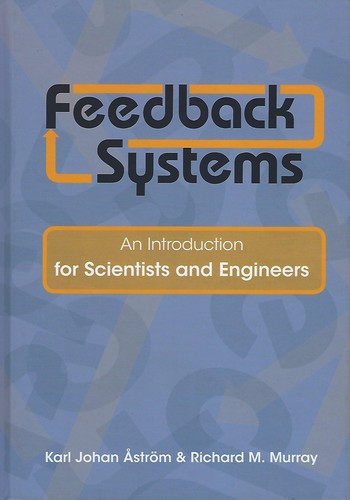
Åström, K. J., & Murray, R. M. (2008). Feedback Systems: An Introduction for Scientists and Engineers. Princeton University Press.
Why It Matters
The engineering collection already covers mechanics, circuits, fluid mechanics, thermodynamics, structures, and microelectronics, but it lacks a central control text. Feedback systems provide the language for making machines, biological processes, and networks behave reliably under uncertainty.
Core Ideas
Modeling Dynamic Systems
Control begins with a model of how inputs change a system over time. Good models preserve the behavior that matters while leaving irrelevant detail aside.
Feedback and Stability
Feedback can reduce uncertainty and improve performance, but poorly designed feedback can amplify disturbances or destabilize a system. Stability is therefore a design question, not just a mathematical property.
State and Observability
State-space models describe what a system remembers. Observability and estimation determine whether hidden internal conditions can be inferred from available measurements.
Robustness
Real systems have unmodeled dynamics, delays, disturbances, and parameter uncertainty. Robust design asks how much performance survives when the model is wrong.
Reading Lens
For each example, identify the plant, sensor, controller, actuator, disturbance, and desired output. Then compare open-loop and closed-loop behavior before doing the algebra.
Conclusion
Feedback Systems gives control theory a broad systems perspective without losing mathematical discipline. It is a useful bridge from engineering fundamentals to robotics, aerospace, biology, and networked systems.