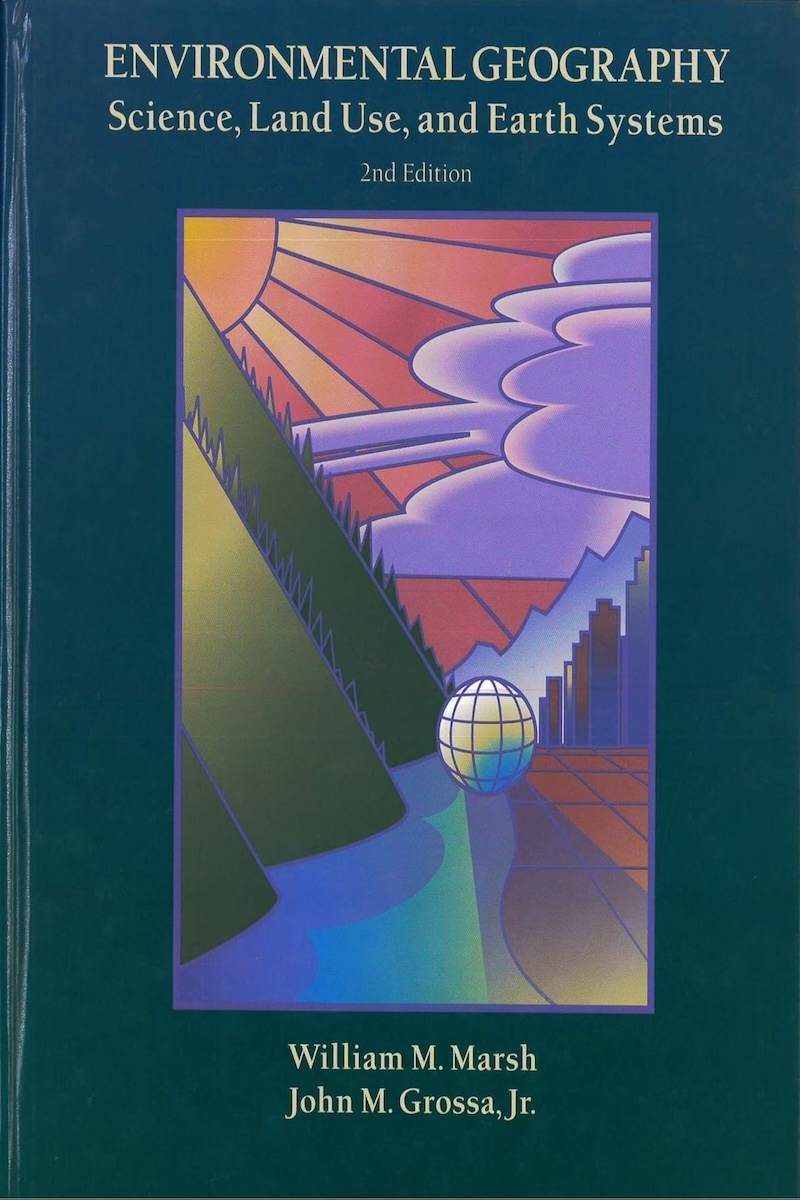
01 / Classic Textbook Recommendation
Classic Textbook Recommendation
Citation
Marsh, W. M., Kaufman, M. M., & Grossa, J. (2024). Environmental Geography: Science, Land Use, and Earth Systems (5th ed.). John Wiley & Sons.
Knowledge and Historical Context
Environmental geography emerged in the 1960s and 1970s as geography engaged with growing environmental awareness and the environmental movement. The field developed at the intersection of physical geography, human geography, and environmental science, drawing from both natural and social sciences to understand environmental problems.
This textbook represents the mature phase of environmental geography, integrating systems thinking, sustainability science, and spatial analysis to address contemporary environmental challenges. It reflects the field's evolution from descriptive environmental studies to analytical frameworks for understanding human-environment interactions.
Educational Philosophy
The textbook emphasizes that environmental problems are inherently geographic, involving spatial patterns, scale interactions, and place-specific contexts. It teaches students to think systemically about environmental issues while developing skills for environmental problem-solving and sustainable resource management.
Core Concepts
Environmental Systems and Earth Systems Science
Introduction to systems thinking, Earth system components, energy flows, and feedback mechanisms in environmental systems.
Climate and Climate Change
Global and regional climate systems, climate change science, impacts and adaptation, and the geographic dimensions of climate variability.
Water Resources and Hydrology
Water cycle, watershed management, water quality, water scarcity, and the geographic patterns of water resources and use.
Soil Resources and Land Degradation
Soil formation, soil geography, erosion processes, desertification, and sustainable soil management practices.
Vegetation and Biodiversity
Biogeographic patterns, ecosystem services, biodiversity conservation, habitat fragmentation, and landscape ecology.
Natural Hazards and Environmental Risk
Geographic patterns of natural hazards, vulnerability assessment, risk management, and the human dimensions of environmental hazards.
Land Use and Land Cover Change
Urban sprawl, deforestation, agricultural expansion, and the environmental impacts of land use change.
Environmental Policy and Management
Environmental governance, resource management strategies, protected areas, and the role of geography in environmental policy.
Significance and Impact
This textbook has shaped environmental geography education by providing an integrated approach that bridges physical and human geography perspectives on environmental issues. Its systems approach has influenced how environmental problems are conceptualized and studied across multiple disciplines.
The book's emphasis on practical applications and case studies has helped establish environmental geography as a field relevant to environmental management, policy-making, and sustainability planning.
Conclusion
Environmental Geography provides essential knowledge for understanding the spatial dimensions of environmental problems and solutions. Its integrated approach to human-environment interactions prepares students for careers in environmental science, natural resource management, and sustainability planning.
The textbook's combination of scientific rigor with policy relevance makes it valuable for students pursuing graduate study in environmental fields or careers requiring understanding of environmental systems and sustainable resource management.