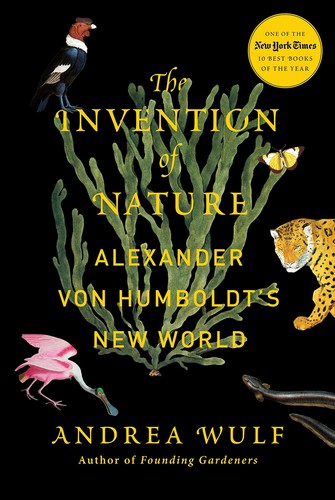
01 / Classic Textbook Recommendation
Classic Textbook Recommendation
Citation
Wulf, A. (2015). The Invention of Nature: Alexander von Humboldt's New World. Alfred A. Knopf.
Why It Matters
Andrea Wulf presents Humboldt as a thinker who connected landscapes, climate, plants, animals, and human societies rather than treating nature as a collection of separate facts. His work helps explain why geography is both a study of place and a study of relationships across space.
Core Ideas
Nature as a Network
Humboldt described nature as a web of interdependence. Changes in one part of a landscape could alter soils, water, vegetation, climate, and human life elsewhere.
Mapping Patterns
Measurements, maps, and visual comparisons made it possible to see patterns that were not obvious from a single field observation. The method links local experience to global scale.
Science and Exploration
The book also shows that geographical knowledge was produced through travel, instruments, institutions, and imperial networks. Scientific achievement therefore has a social and political history.
An Early Environmental Imagination
Humboldt connected human activity with environmental change long before climate change became a modern public concern. His approach remains relevant to physical geography and environmental studies.
Reading Lens
Track how an observation becomes a map, a comparison, and finally a theory about the Earth. Also ask whose labor, travel, and local knowledge make the production of geographical knowledge possible.
Conclusion
The Invention of Nature is an inviting entry point into geographical thought. It shows how a relational view of the Earth can connect fieldwork, visualization, history, and environmental responsibility.