01 / Reading Guide
Reading Guide
Citation
Trefethen, L. N., & Bau, D., III. (2022). Numerical Linear Algebra (25th anniversary ed.). SIAM.
Chapter Summary
The book is organised as forty short lectures, each built around one or two central ideas. The lectures are grouped into six parts and followed by an appendix, notes and a bibliography. The original 1997 text runs to about 360 pages.
Part I, Fundamentals (Lectures 1–5): Matrix-Vector Multiplication; Orthogonal Vectors and Matrices; Norms; The Singular Value Decomposition; More on the SVD
The opening lectures re-read familiar linear algebra with computation in mind. Lecture 1 treats a matrix-vector product as a linear combination of the columns, extends the idea to matrix-matrix products, and covers range, nullspace and the inverse. Orthogonality and norms follow. The part ends with the singular value decomposition, which the later parts keep returning to.
Part II, QR Factorization and Least Squares (Lectures 6–11): Projectors; QR Factorization; Gram-Schmidt Orthogonalization; MATLAB; Householder Triangularization; Least Squares Problems
Projectors lead to the reduced and full QR factorizations. These are computed first by Gram-Schmidt orthogonalization and then by Householder triangularization. Lecture 9 is a short MATLAB lecture, and the part closes with the use of these factorizations to solve least squares problems.
Part III, Conditioning and Stability (Lectures 12–19): Conditioning and Condition Numbers; Floating Point Arithmetic; Stability; More on Stability; Stability of Householder Triangularization; Stability of Back Substitution; Conditioning of Least Squares Problems; Stability of Least Squares Algorithms
This part supplies the vocabulary for judging algorithms. It covers how sensitive a problem is, how floating point arithmetic behaves, and what it means for an algorithm to be stable. The ideas are then applied to the algorithms of Part II and to back substitution, so that the earlier methods are analysed rather than merely stated.
Part IV, Systems of Equations (Lectures 20–23): Gaussian Elimination; Pivoting; Stability of Gaussian Elimination; Cholesky Factorization
Gaussian elimination appears here, after QR, together with pivoting and an analysis of its stability. Cholesky factorization for symmetric positive definite matrices completes the part.
Part V, Eigenvalues (Lectures 24–31): Eigenvalue Problems; Overview of Eigenvalue Algorithms; Reduction to Hessenberg or Tridiagonal Form; Rayleigh Quotient, Inverse Iteration; QR Algorithm without Shifts; QR Algorithm with Shifts; Other Eigenvalue Algorithms; Computing the SVD
The eight lectures lay out the problem and reduce matrices to Hessenberg or tridiagonal form. They then study Rayleigh quotient and inverse iteration and develop the QR algorithm without and with shifts. They close with other eigenvalue algorithms and the computation of the SVD.
Part VI, Iterative Methods (Lectures 32–40): Overview of Iterative Methods; The Arnoldi Iteration; How Arnoldi Locates Eigenvalues; GMRES; The Lanczos Iteration; From Lanczos to Gauss Quadrature; Conjugate Gradients; Biorthogonalization Methods; Preconditioning
Krylov subspace methods are built up through Arnoldi and Lanczos. They are applied to eigenvalue problems and to linear systems through GMRES, conjugate gradients and biorthogonalization methods, with preconditioning last.
Appendix and back matter
The appendix, "The Definition of Numerical Analysis", is followed by Notes that give sources and further reading, a bibliography and an index. Each lecture ends with exercises.
Key Concepts
Parts I–II
- Matrix-vector product as a combination of columns: the viewpoint introduced in Lecture 1 and used throughout.
- Singular value decomposition: a factorization introduced in Lecture 4 and revisited in Lectures 5 and 31.
- QR factorization: computed by Gram-Schmidt or Householder triangularization and applied to least squares.
Part III
- Condition number: a measure of how sensitive a problem is to perturbation.
- Floating point arithmetic and stability: the framework for judging whether an algorithm's answers are trustworthy.
Parts IV–VI
- Gaussian elimination with pivoting and Cholesky factorization: direct methods for linear systems.
- QR algorithm: the main eigenvalue method, developed with and without shifts.
- Krylov methods: Arnoldi, Lanczos, GMRES, conjugate gradients and preconditioning.
Critical Analysis
Strengths
- A clear stated design. The preface presents the book as a one-semester text scaled to a university course. It is built from forty lectures that each concentrate on one or two ideas and avoid getting lost in detail.
- QR before Gaussian elimination. The authors deliberately depart from the usual order. They explain that Gaussian elimination is atypical of the subject and hard to analyse, whereas QR factorization is the thread connecting least squares, eigenvalue, singular value and iterative methods.
- Conditioning and stability get a full part. Eight lectures treat these themes before any system-solving algorithm is analysed, and the stability analyses of later parts rely on them.
- A usable structure. Short lectures with exercises suit a course taught lecture by lecture, and the six-part layout makes it easy to see which lectures belong together. The University of Florida course described below uses the book as its required text. Its outline moves through the following units:
- fundamentals and the SVD
- QR and least squares
- conditioning and stability
- systems of equations
- eigenvalues
- iterative methods
Limitations
- Deliberately not a reference. The authors state that the book does not try to duplicate the encyclopedic Golub and Van Loan treatment. It is scaled to one semester. For further detail and additional topics, they expect readers to consult Golub and Van Loan, along with the books by Higham and Demmel described in the Notes.
- The CSci 5304 course described below lists Matrix Computations (4th ed.) as the preferred main reference, especially for research involving numerical linear algebra.
- Its instructor describes Trefethen and Bau as accessible and insightful but less detailed and less complete.
- Compact exposition. With forty lectures of roughly eight pages each, derivations are brief. Readers also need comfort with linear algebra in complex vector spaces, which the book adopts as its default setting.
- Iterative-method coverage is conditional. In MAD 6406 the iterative-methods unit is scheduled "time permitting", so it may not be covered fully. In CSci 5304, sparse techniques, Lanczos methods and Krylov subspaces are likewise conditional on time.
Where It Fits in the Course
This is the specialised linear algebra text in the numerical analysis course. It does not replace a general numerical analysis book; instead, it goes deeper on one thread. Two broader introductions can come first:
- Burden, Faires and Burden's Numerical Analysis
- Süli and Mayers' An Introduction to Numerical Analysis, which is more concerned with proofs of convergence
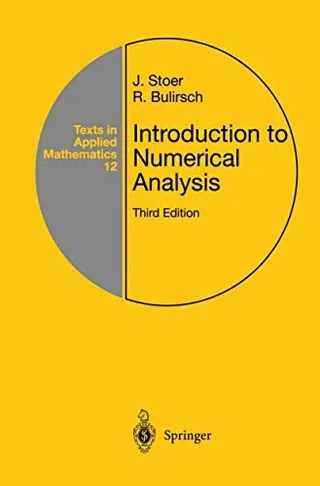
Stoer and Bulirsch's Introduction to Numerical Analysis is a comprehensive graduate text. It covers more ground and overlaps with this book on linear systems and eigenvalues.
Some readers want to program before they analyse. For them, Moler's Numerical Computing with MATLAB and the Python-based book on numerical methods are gentler and more hands-on starting points. Trefethen and Bau then supply the geometric and stability-based understanding behind routines such as the ones those books call.
In both Fall 2025 courses described below, the book appears alongside Golub and Van Loan's Matrix Computations, though in different roles:
- MAD 6406: Trefethen and Bau is required, and Matrix Computations (3rd ed.) is "highly recommended".
- CSci 5304: the order is reversed. There is no required text, and Trefethen and Bau is the second of two optional references.
How to Use This Book
The book suits several groups of readers:
- first-year graduate students and advanced undergraduates in applied mathematics, scientific computing and engineering
- anyone who uses matrix algorithms and wants to know why they work
A good undergraduate linear algebra course is the main prerequisite. Some programming practice in MATLAB, Python or Julia is useful for the computational exercises. Both courses below ask for similar preparation:
- MAD 6406 requires a linear algebra course (MAS 3114, 4105 or 4124) plus a programming language.
- CSci 5304 requires a good linear algebra background, with CSci 2033 or an equivalent, and familiarity with MATLAB or Python with NumPy/SciPy.
A practical plan:
- Core: read Parts I–III in order. Lectures 1–5 on the SVD, Lectures 6–11 on QR and Lectures 12–15 on conditioning and stability carry most of the concepts that the rest of the book assumes.
- Next: read Part V on eigenvalues and Part VI on iterative methods. Each can be read as a unit once the SVD, QR and stability are familiar. Part IV can be read earlier if Gaussian elimination is the immediate need.
- Alongside: implement the algorithms as they appear, work the lecture exercises, and read the Notes for sources and further reading. Keep a larger reference at hand for topics beyond the forty lectures.
Common course assignments
- As the required text: University of Florida MAD 6406, Fall 2025 (syllabus).
- The outline runs through six units labelled Ch 1–6, with iterative methods last and marked "time permitting".
- These labels are the course's own and come without lecture numbers or page ranges, so match the topics to the lecture titles in your copy.
- The course also covers positive-definite and Toeplitz systems as course topics rather than as assigned book readings.
- As an optional reference: CSci 5304, Computational Aspects of Matrix Theory, Fall 2025, hosted on the University of Minnesota's site (syllabus PDF).
- No chapters or pages are assigned.
- The book is listed second after Matrix Computations.
- As an optional companion, it can be consulted for explanations of QR, the SVD, conditioning and eigenvalue algorithms as those topics arise.
Edition notes
Both courses cite the 1997 SIAM publication without a numbered edition, and the CSci 5304 listing specifies the paperback. The edition listed here is the 2022 25th anniversary edition. If you are following one of these courses, check page and section references against the printing your instructor names rather than assuming they match.