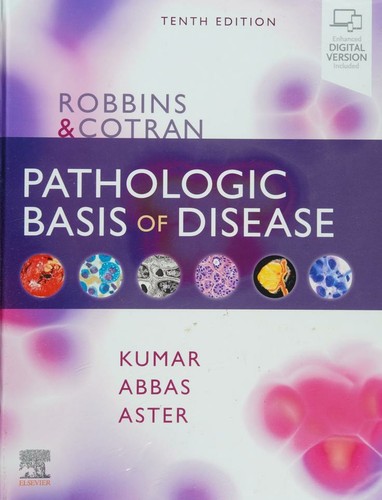
01 / Classic Textbook Recommendation
Classic Textbook Recommendation
Citation
Kumar, V., Abbas, A. K., & Aster, J. C. (2021). Robbins and Cotran Pathologic Basis of Disease (10th ed.). Elsevier.
Why It Matters
Pathology is the explanatory center of medicine: it connects molecular mechanisms to symptoms, laboratory findings, and the structure of damaged organs. This text gives students a framework for understanding disease rather than memorizing isolated diagnoses.
Core Ideas
Cellular Injury and Adaptation
Cells respond to stress through adaptation, reversible injury, or death. The distinction explains why the same insult can produce recovery in one setting and irreversible damage in another.
Inflammation and Repair
Inflammation protects tissues while also creating the conditions for collateral damage. Repair, fibrosis, and regeneration determine whether an injury resolves or becomes chronic disease.
Neoplasia
Cancer is presented as a disorder of genetic regulation, cell growth, tissue organization, and host response. The framework links mutations to tumor behavior without reducing cancer to a single cause.
Disease Across Organ Systems
The organ-system chapters apply general mechanisms to recognizable clinical patterns. This makes pathology a bridge between basic science, diagnosis, and patient care.
Reading Lens
For each disease, move through the same sequence: cause, mechanism, structural change, clinical consequence, and diagnostic evidence. Reconstructing that chain is more valuable than highlighting every named lesion.
Conclusion
Robbins and Cotran Pathologic Basis of Disease is a foundational reference for medical students and health-science learners. It turns pathology into a coherent language for explaining how disease changes the human body.