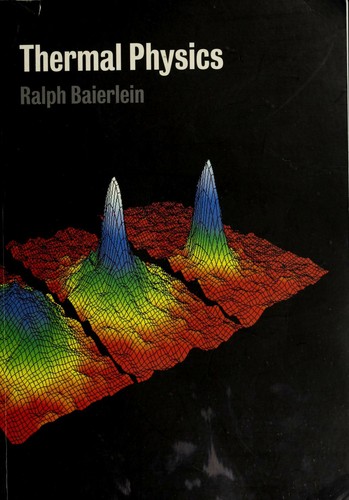
01 / Classic Textbook Recommendation
Classic Textbook Recommendation
Citation
Baierlein, R. (1999). Thermal Physics. Cambridge University Press.
Why It Matters
Thermal physics explains how simple microscopic rules can produce the regular behavior of pressure, temperature, heat, and entropy. The subject is a meeting point for mechanics, probability, and experimental science.
Core Ideas
Macroscopic State Variables
Temperature, pressure, volume, and chemical potential summarize the state of a system. Thermodynamics studies how these variables constrain possible changes without tracking every particle.
Entropy and Probability
Statistical mechanics gives entropy a microscopic interpretation through the number and weight of accessible states. Irreversibility becomes a statement about overwhelmingly likely behavior rather than a new mechanical force.
Ensembles and Fluctuations
Different ensembles describe different experimental constraints. They also make clear why small systems fluctuate more visibly than large systems.
Quantum Statistics
At low temperatures or high densities, the distinction between bosons and fermions changes how states are occupied. Quantum statistics explains effects that classical models cannot capture.
Reading Lens
Move back and forth between a thermodynamic statement and its statistical interpretation. Check which variables are held fixed, what counts as a microstate, and where an approximation enters.
Conclusion
Thermal Physics is a compact route into a subject that often feels divided between thermodynamics and statistical mechanics. Its strength is showing that the two languages describe the same physical world at different levels.