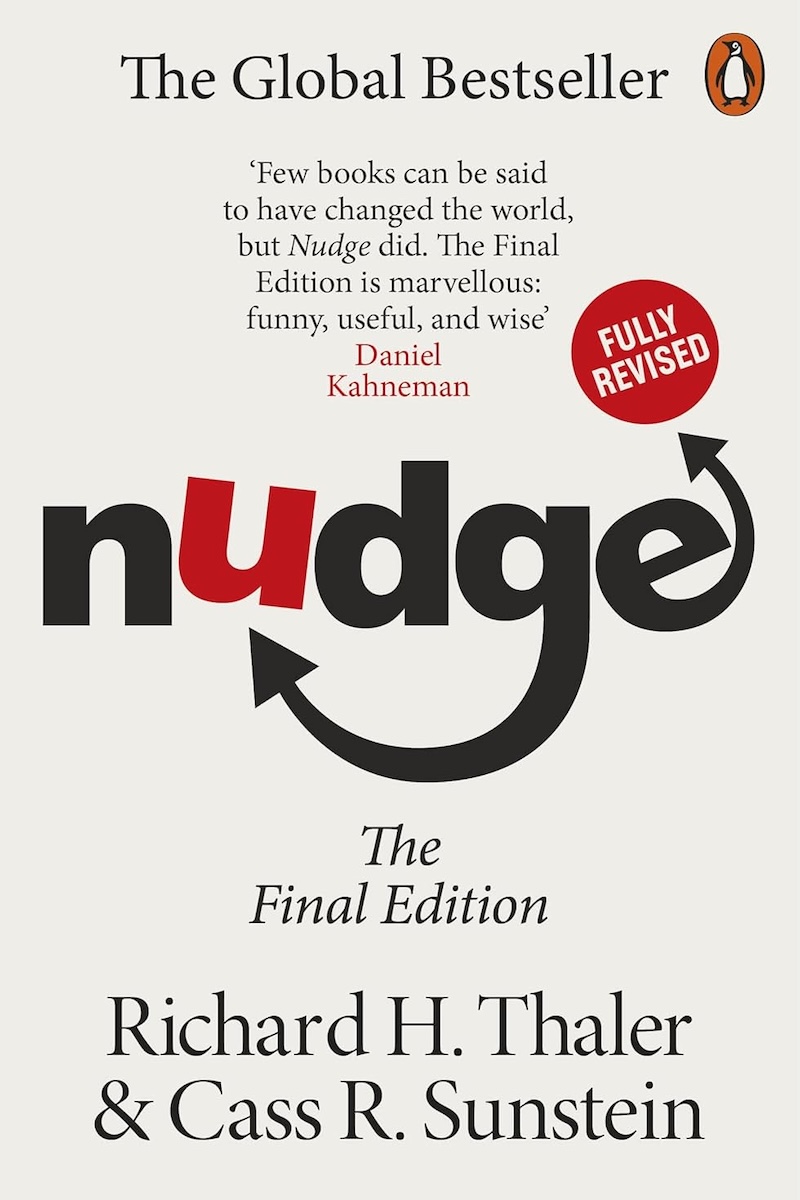
01 / Classic Textbook Recommendation
Classic Textbook Recommendation
Part 1. Citation, Context, Thesis & Key Concepts
Citation
Thaler, R. H., & Sunstein, C. R. (2008). Nudge: Improving decisions about health, wealth, and happiness. Yale University Press.
Author & Publication Information
- Authors: Richard H. Thaler (Nobel Prize winner in Economics, 2017), University of Chicago Booth School of Business, and Cass R. Sunstein, Harvard Law School and former Obama administration official.
- Publication: First published in 2008; updated edition released in 2021 with new research and applications from the digital age.
Intellectual & Historical Context
- Emerged from the behavioral economics revolution of the 1990s-2000s, building on work by Kahneman, Tversky, and others on cognitive biases.
- Written during growing recognition that traditional economic models of rational choice failed to predict real human behavior.
- Influenced by the rise of evidence-based policy and randomized controlled trials in government.
- Published as governments worldwide sought alternatives to both heavy-handed regulation and pure free-market approaches.
Thesis Statement
Thaler and Sunstein argue that since people are predictably irrational and choice architects inevitably influence decisions, we should design choice environments—"nudge"—to help people make choices that improve their lives according to their own stated preferences, while preserving their freedom to choose otherwise (libertarian paternalism).
Key Concepts
- Choice Architecture: The design of environments in which people make decisions, which inevitably influences outcomes.
- Libertarian Paternalism: A philosophy that seeks to influence choices for people's benefit while preserving their freedom.
- Nudges: Interventions that steer people in particular directions but preserve their ability to go their own way.
- System 1 vs System 2: Building on Kahneman's dual-process theory to explain automatic vs. deliberative decision-making.
- Econs vs Humans: Contrasting the rational actors of economic theory with real people who use heuristics and make predictable errors.
- NUDGES: Tools for choice architects (iNcentives, Understand mappings, Defaults, Give feedback, Expect error, Structure complex choices).
Part 2. Chapter Summaries
Part I: Humans and Econs
- Chs. 1–2: Introduces the contrast between "Econs" (perfectly rational economic actors) and "Humans" (real people with biases). Explains how choice architecture affects decisions whether we plan it or not.
Part II: Money
- Chs. 3–6: Applies nudging to financial decisions:
- Save More Tomorrow: Automatic enrollment and escalation in retirement savings
- Naive Investing: How to improve portfolio choices through better defaults
- Credit Cards and Mortgages: Protecting consumers from predatory lending
- Prescription Drug Plans: Simplifying complex Medicare choices
Part III: Health
- Chs. 7–8: Health-related applications:
- Organ Donation: How opt-out vs opt-in policies dramatically affect donation rates
- Prescription Drug Plans: Medicare Part D and the importance of intelligent design
Part IV: Freedom
- Chs. 9–11: Addresses objections to nudging:
- Privatizing Social Security: A libertarian approach to retirement security
- Privatizing Marriage: Separating civil and religious marriage
- Environmental Protection: Market-based approaches to climate change
Part V: Extensions and Objections
- Chs. 12–17: Broader applications and responses to critics:
- A Dozen Nudges: Practical applications from school choice to charitable giving
- Objections: Addressing concerns about manipulation, slippery slopes, and government overreach
- The Real Third Way: How nudging offers an alternative to traditional left-right political frameworks
Conclusion
- Ch. 18: Nudging as a general approach to improving human welfare while respecting individual choice and dignity.
Part 3. Key Quotes & Significance
Key Quotes
- "A nudge, as we will use the term, is any aspect of the choice architecture that alters people's behavior in a predictable way without forbidding any options or significantly changing their economic incentives."
- "Libertarian paternalism is a relatively weak, soft, and nonintrusive type of paternalism because choices are not blocked, fenced off, or significantly burdened."
- "If you want to encourage someone to do something, make it easy."
- "In many cases, individuals make pretty bad decisions—decisions they would not have made if they had paid full attention and possessed complete information, unlimited cognitive abilities, and complete self-control."
- "Choice architects have the responsibility for organizing the context in which people make decisions."
Significance & Impact
- Global Policy Adoption: Led to the creation of "nudge units" in governments worldwide, including the UK's Behavioural Insights Team, the first such unit.
- Behavioral Public Policy: Established behavioral economics as a legitimate tool for policymaking, moving beyond pure regulation or market solutions.
- Academic Influence: Spawned thousands of academic papers and became a standard framework in policy schools and economics departments.
- Business Applications: Companies adopted choice architecture principles in product design, marketing, and employee benefits.
- Democratic Innovation: Provided a "third way" between heavy-handed government intervention and pure laissez-faire approaches.
Broader Implications
- Challenges both libertarian and authoritarian approaches to governance.
- Demonstrates how insights from psychology can improve real-world outcomes.
- Raises important questions about manipulation, consent, and who decides what's "good" for people.
- Shows how small changes in context can have large behavioral effects.
- Bridges the gap between academic research and practical policy implementation.
- Influences debates about digital platform design and "dark patterns" in technology.