01 / Classic Textbook Recommendation
Classic Textbook Recommendation
Citation
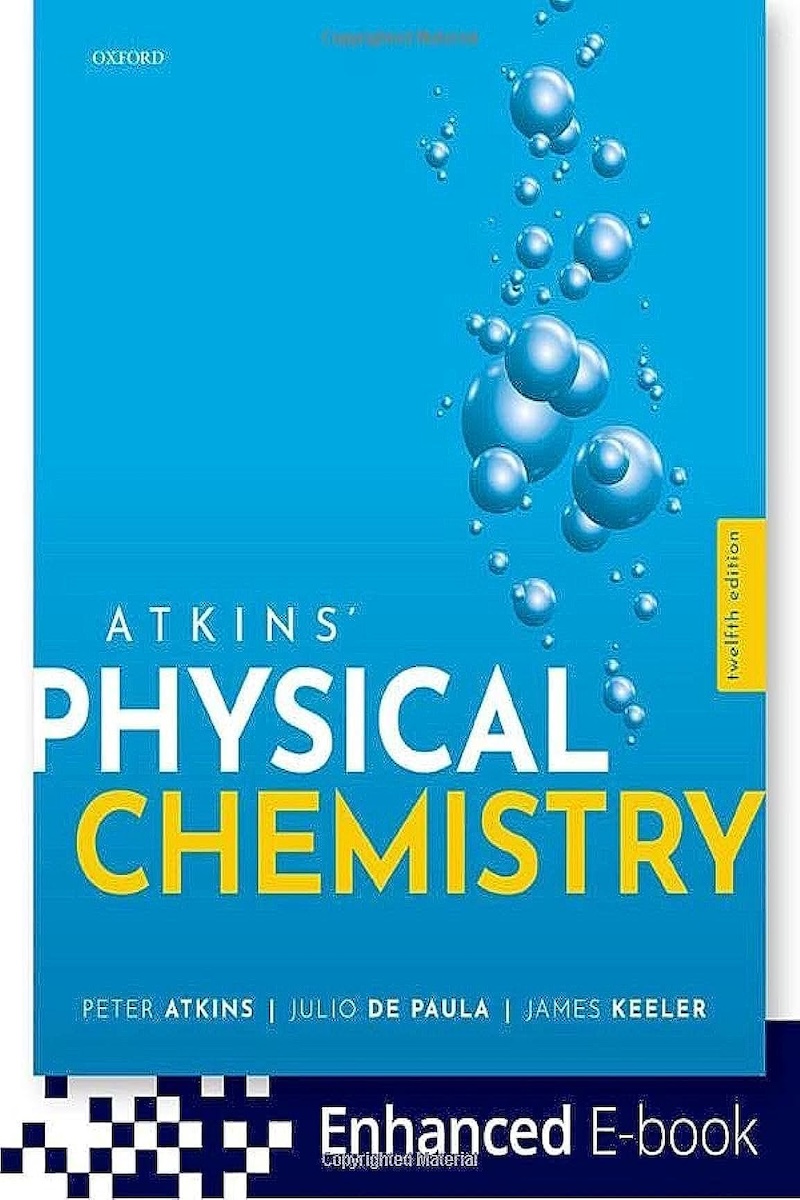
Atkins, P., de Paula, J., & Keeler, J. (2022). Physical Chemistry (12th ed.). Oxford University Press.
Knowledge and Historical Background
"Physical Chemistry" by Peter Atkins first appeared in 1978 and has since become the most widely used physical chemistry textbook worldwide. Peter Atkins, a Fellow of Lincoln College, Oxford, revolutionized physical chemistry education by making complex mathematical concepts accessible through clear explanations and innovative pedagogical approaches.
The book has evolved through twelve editions, with contributions from Julio de Paula and James Keeler, incorporating advances in computational chemistry, spectroscopy, and materials science. The text represents decades of refinement in teaching physical chemistry to undergraduate and graduate students.
Teaching Philosophy
The textbook is built on the principle that physical chemistry requires mathematical sophistication but should be taught with clarity and logical progression. It emphasizes the connection between macroscopic observations and molecular-level phenomena, helping students develop both conceptual understanding and computational skills.
Core Concepts
Thermodynamics
Comprehensive treatment of the laws of thermodynamics, including internal energy, enthalpy, entropy, and free energy, with applications to chemical equilibria and phase transitions.
Quantum Mechanics
Introduction to quantum theory and its applications to atomic and molecular systems, including particle in a box, harmonic oscillator, and hydrogen atom models.
Chemical Kinetics
Rates of chemical reactions, reaction mechanisms, and the factors that influence reaction rates, including temperature, concentration, and catalysis.
Statistical Mechanics
Connection between molecular properties and macroscopic thermodynamic quantities through statistical methods and ensemble theory.
Spectroscopy
Rotational, vibrational, and electronic spectroscopy as tools for understanding molecular structure and dynamics.
Electrochemistry
Thermodynamics and kinetics of electrochemical processes, including electrode potentials, electrolysis, and corrosion.
Surface Chemistry and Catalysis
Adsorption, heterogeneous catalysis, and the unique properties of surfaces and interfaces.
Computational Chemistry
Modern computational methods for calculating molecular properties and predicting chemical behavior.
Significance and Impact
"Physical Chemistry" by Atkins has defined the standard for physical chemistry education for over four decades. Its influence extends far beyond the classroom, with many practicing chemists and chemical engineers relying on it as a reference throughout their careers.
The textbook's emphasis on clear mathematical development and physical insight has shaped how physical chemistry is taught worldwide. Its problems and exercises have become benchmarks for understanding, and its approach has influenced numerous other textbooks in the field.
Conclusion
This textbook remains the gold standard for physical chemistry education, successfully combining mathematical rigor with pedagogical clarity. Its comprehensive coverage and logical organization make it invaluable for students pursuing advanced study in chemistry, chemical engineering, and related fields.
The continuing evolution of the text through multiple editions ensures that it remains current with advances in the field while maintaining the clarity and accessibility that have made it a classic. For students seeking to master the mathematical and conceptual foundations of chemistry, this book provides an unparalleled resource that will serve them throughout their scientific careers.