01 / Classic Textbook Recommendation
Classic Textbook Recommendation
Who this book is for
First-year PhD and research master's students in economics, advanced undergraduates in honours macroeconomics courses, and economists in central banks or policy institutions who want a rigorous refresher on the models behind contemporary macroeconomic debate. Readers should be prepared for sustained mathematical argument, though the book is less formal than measure-theoretic treatments.
Prerequisites
Intermediate macroeconomics, multivariable calculus and basic differential equations; some exposure to dynamic optimisation and econometrics helps.
What it covers
The text begins with the Solow growth model, infinite-horizon and overlapping-generations models, and endogenous growth, then turns to cross-country income differences. It develops real-business-cycle theory, nominal rigidity and dynamic stochastic general equilibrium models of fluctuations, before covering consumption, investment, financial markets and crises, unemployment, monetary policy including inflation targeting and the zero lower bound, and fiscal policy and government debt. Empirical applications and problem sets accompany each topic.
How to use it
Work through the chapters in order, deriving the key results yourself and attempting the end-of-chapter problems, which frequently anticipate later material. Many instructors pair the book with journal articles cited in the text. Keep a reference on dynamic optimisation nearby for the continuous-time sections.
Edition and sources
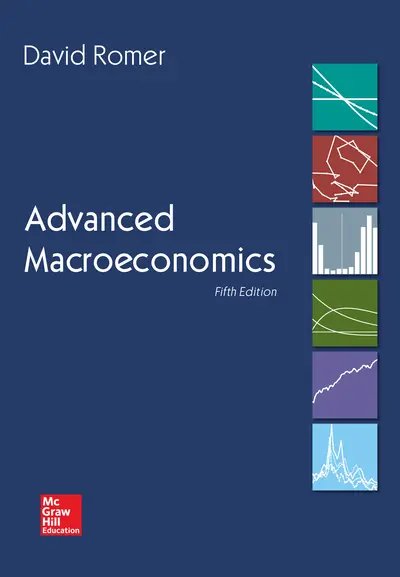
Fifth edition published by McGraw-Hill Education with a 2019 copyright. The ISBN recorded here is the hardcover print edition; ebook and loose-leaf formats carry separate ISBNs, and the publisher's page lists this edition as current. Bibliographic data comes from McGraw-Hill Education.