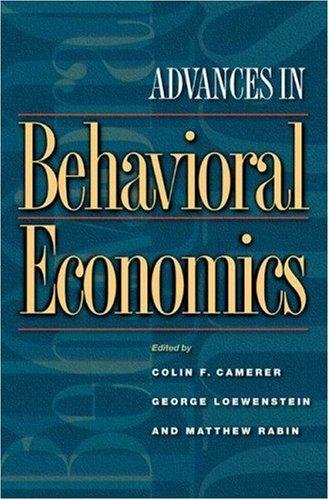
01 / Classic Textbook Recommendation
Classic Textbook Recommendation
Who this book is for
PhD students and advanced master's students in economics taking a field course in behavioural economics, and researchers in finance, labour or public economics who want the primary literature in one place. Readers coming from psychology or neuroscience will find it a useful guide to how economists formalise decision-making anomalies and test them against data.
Prerequisites
Graduate microeconomics and familiarity with reading research articles in economics are assumed.
What it covers
The editors' introductory essay surveys the field and its methods. The reprinted papers address reference dependence and loss aversion, the endowment effect, intertemporal choice and hyperbolic discounting, self-control, fairness and social preferences, reciprocity in markets, learning in games, and applications to finance, labour markets, savings and consumption. Taken together, the selections show how a small number of psychological regularities were turned into tractable models that could be used in applied work.
How to use it
Start with the editors' introduction, which places each paper in context. Then read the sections relevant to your course or research, giving priority to the model-building papers, and follow up with the later literature that cites, extends or tests them.
Edition and sources
This record describes the paperback issued by Princeton University Press with the Russell Sage Foundation, released at the end of 2003 with a 2004 copyright date. Bibliographic data comes from the Google Books catalog page and the Open Library record.