01 / Reading Guide
Reading Guide
Who this book is for
For advanced undergraduate or graduate readers who want to understand the models behind a solid-mechanics simulation. The electronic text offers a substantial free route beyond elementary beam calculations. It is especially useful for readers who can obtain numerical results but need to justify their constitutive assumptions, boundary conditions and interpretation of failure.
Prerequisites
Mechanics of materials, multivariable calculus, linear algebra and differential equations. Review stress, strain, equilibrium and vector notation before working through the continuum models.
What it covers
Deformation, forces and material response lead to analytical solutions, finite-element analysis and failure models. Structural theories for special geometries complement the continuum treatment. The framework makes it possible to compare an engineering simplification with a more general mathematical description of the same component.
How to use it
Begin by specifying the body, loading, constraints and material law before choosing software. Solve a small case analytically when possible and use it as a numerical check. Change the mesh, boundary conditions or constitutive parameters separately to identify the source of a difference. Keep a distinction between numerical convergence and physical validity, and state which mechanisms the model cannot represent.
Edition and sources
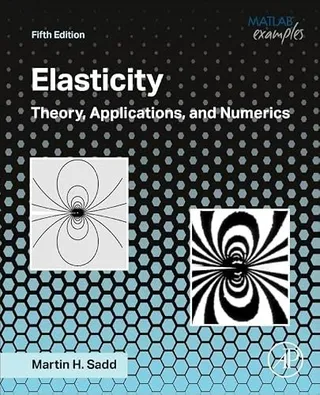
The author’s electronic text is freely available and includes its own problems and code demonstrations. It is related to the commercial book but has a different arrangement of problem material. This online record does not borrow the ISBN, numbered edition or publication year of a print format.