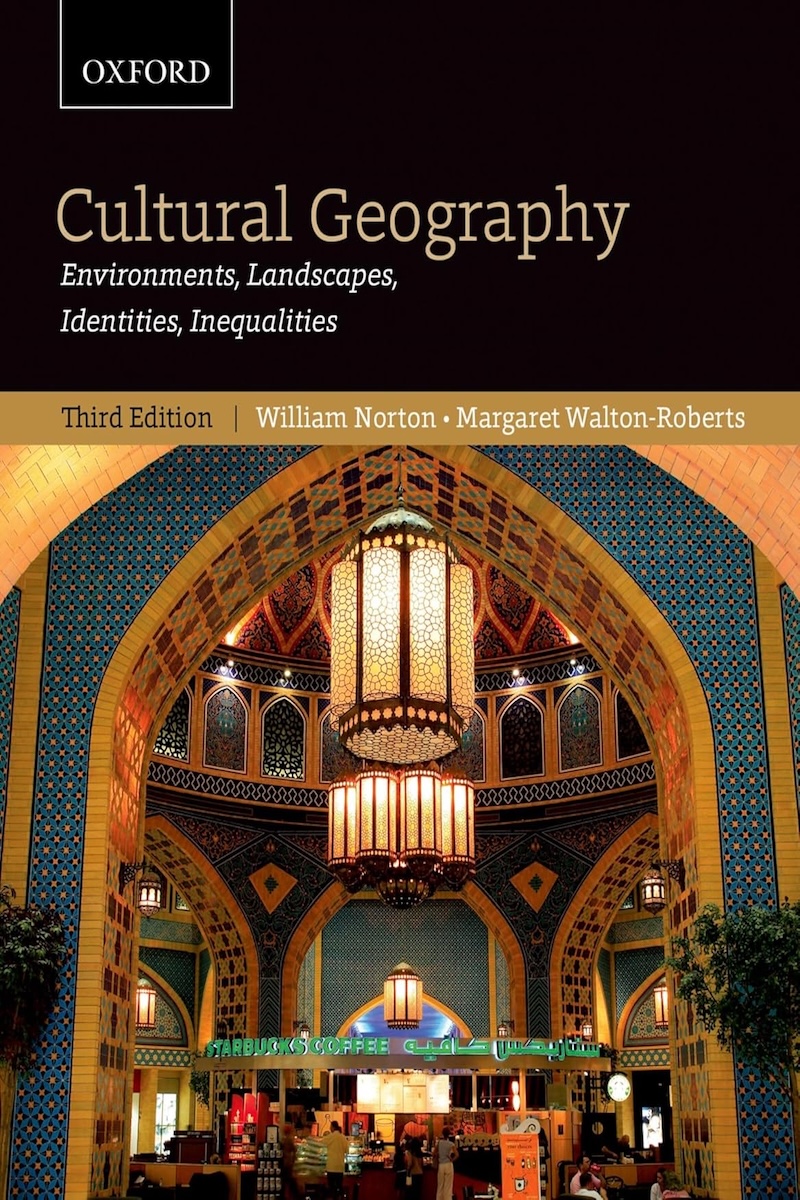
01 / Classic Textbook Recommendation
Classic Textbook Recommendation
Citation
Norton, W., & Walton-Roberts, M. (2013). Cultural Geography: Environments, Landscapes, Identities, Inequalities (3rd ed.). Oxford University Press.
Knowledge and Historical Context
Cultural geography emerged from the Berkeley School tradition established by Carl Sauer in the early 20th century, emphasizing the study of cultural landscapes and human-environment relationships. The field evolved through various theoretical phases including cultural ecology, humanistic geography, and contemporary critical approaches.
This textbook represents the contemporary phase of cultural geography, incorporating post-structuralist theory, feminist geography, and postcolonial perspectives to examine how culture and space are mutually constituted. It reflects the field's engagement with issues of power, identity, and difference in spatial context.
Educational Philosophy
The textbook emphasizes that culture and space are inseparable, with cultural practices both shaping and being shaped by geographic contexts. It teaches students to examine critically how cultural meanings are produced, contested, and transformed through spatial practices and place-making processes.
Core Concepts
Culture and Geographic Thought
Introduction to cultural geography concepts, evolution of cultural geographic thought, and theoretical approaches to understanding culture-space relationships.
Cultural Landscapes and Material Culture
Reading cultural landscapes, built environments, material culture, and the ways human activities inscribe meaning onto places.
Language and Place
Geography of language, linguistic landscapes, language preservation and loss, and the role of language in place-making and identity formation.
Religion and Sacred Spaces
Religious landscapes, sacred places, pilgrimage, and the spatial dimensions of religious practice and belief systems.
Identity, Difference, and Place
Gender, sexuality, race, class, and other identity categories in spatial context, examining how place shapes identity and vice versa.
Globalization and Cultural Change
Cultural globalization, cultural hybridization, localization processes, and the impacts of global cultural flows on local places.
Popular Culture and Media
Geographies of popular culture, media landscapes, cultural consumption, and the role of technology in cultural transmission.
Heritage and Memory
Cultural heritage, collective memory, commemoration practices, and contested histories in place-making and identity formation.
Significance and Impact
This textbook has influenced cultural geography education by integrating contemporary critical theory with traditional cultural geographic concepts. Its attention to power relations and social difference has shaped how cultural geography engages with issues of identity, inequality, and social justice.
The book's interdisciplinary approach has helped establish cultural geography as a field relevant to cultural studies, anthropology, sociology, and other disciplines concerned with culture and space.
Conclusion
Cultural Geography provides essential knowledge for understanding how culture and place are mutually constituted in contemporary global contexts. Its critical approach to culture-space relationships prepares students for advanced study in cultural geography and related fields.
The textbook's integration of theoretical sophistication with empirical examples makes it valuable for students pursuing careers in cultural resource management, tourism, urban planning, and other fields requiring understanding of cultural processes and place-based identities.