01 / Classic Textbook Recommendation
Classic Textbook Recommendation
Citation
Hobbes, T. (1991). Leviathan (R. Tuck, Ed.). Cambridge University Press. (Original work published 1651).
Intellectual & Historical Context
Leviathan was written by Thomas Hobbes in 1651, during one of the most turbulent periods in English history. The English Civil War (1642-1651) had torn apart the social fabric of the nation, pitting the Royalists supporting King Charles I against the Parliamentarians led by figures like Oliver Cromwell. Hobbes witnessed firsthand the chaos, violence, and breakdown of political authority that accompanied this conflict.
Writing in exile in Paris, Hobbes sought to provide a rational foundation for political authority that could prevent such catastrophic breakdown in the future. The work represents a radical departure from traditional justifications of political power based on divine right or ancient custom, instead grounding political authority in reason and the consent of the governed through social contract.
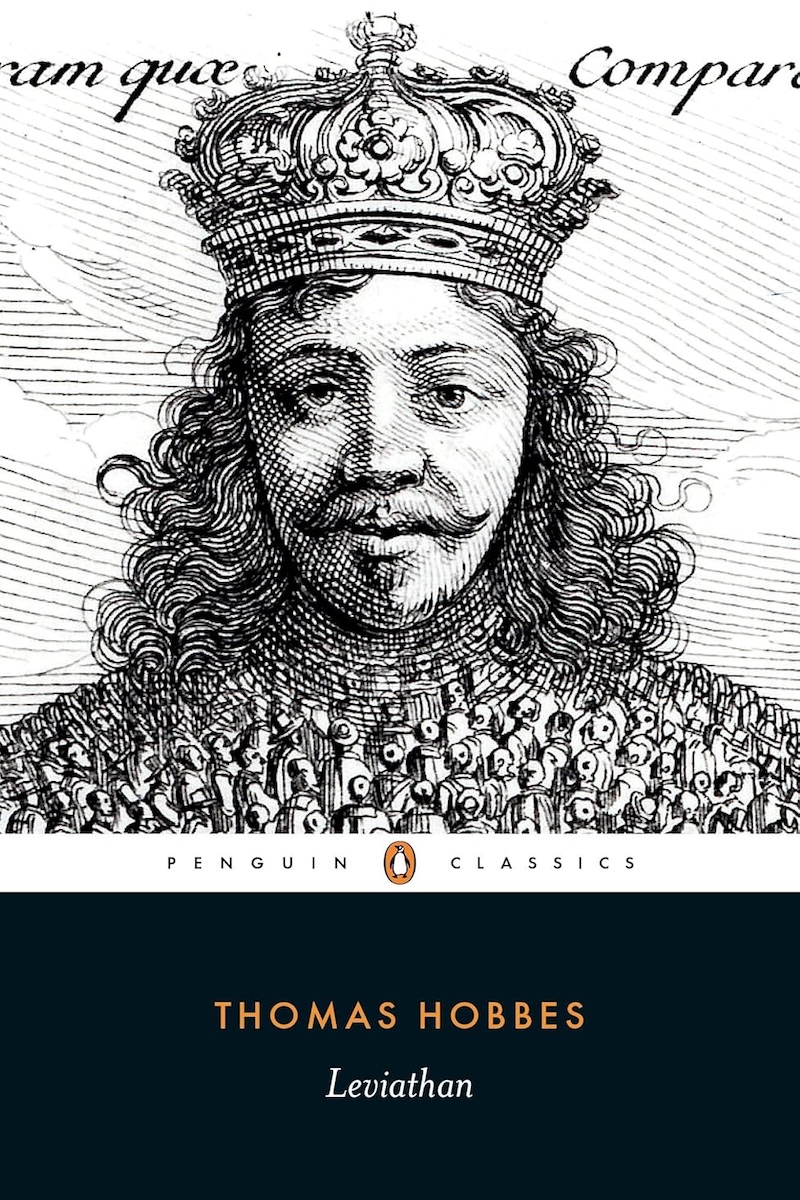
The title "Leviathan" refers to the biblical sea monster mentioned in the Book of Job, which Hobbes uses as a metaphor for the artificial person of the state - a powerful entity created by human agreement to maintain order and peace. The work synthesizes insights from the new mechanical philosophy of Galileo and Harvey with political theory, presenting perhaps the first fully secular and scientific approach to politics.
Thesis Statement
Hobbes argues that in the absence of political authority, human beings exist in a "state of nature" characterized by perpetual conflict and fear - "the war of all against all." To escape this intolerable condition, rational individuals must enter into a social contract, surrendering their natural rights to an absolute sovereign (the Leviathan) who possesses unlimited power to maintain peace and security.
Key Concepts
State of Nature
The hypothetical condition of humanity before the establishment of civil society, characterized by equality, scarcity, and the absence of common authority. In this state, life is "solitary, poor, nasty, brutish, and short."
War of All Against All
Hobbes's famous description of the state of nature, where every individual has the right to everything, leading to constant conflict and insecurity.
Natural Rights
In the state of nature, every person has the natural right to preserve their life by any means necessary, including the right to everything that might be useful for survival.
Laws of Nature
Rational principles discovered by reason that guide human behavior toward peace. The fundamental law is to seek peace when possible, but use war when necessary for self-preservation.
Social Contract
The agreement by which individuals surrender their natural rights to a sovereign authority in exchange for protection and the benefits of civil society.
Absolute Sovereignty
The unlimited political power that the sovereign must possess to effectively maintain order. The sovereign cannot be bound by law since they are the source of all law.
The Leviathan
The artificial person created by the social contract, representing the unified will of the people and possessing absolute authority over them.
Chapter Summaries
Part I: Of Man
Chapters 1-5: Sensation and Imagination
Hobbes begins with a materialist account of human psychology, arguing that all mental phenomena arise from bodily motions caused by external objects. Knowledge derives from sensation, and imagination is merely "decaying sense."
Chapters 6-11: Passions and Power
Analysis of human emotions and motivations, establishing that humans are fundamentally driven by appetite and aversion. Power is defined as present means to obtain future apparent good.
Chapters 12-16: Religion and Language
Discussion of the origins of religion in human ignorance and fear, and the role of language in creating both knowledge and error. Introduction of the concept of artificial persons and representation.
Part II: Of Commonwealth
Chapters 17-18: The Social Contract
The famous chapters establishing the necessity and terms of the social contract. Individuals authorize a sovereign to act on their behalf, creating the Leviathan.
Chapters 19-22: Forms of Government
Analysis of different forms of sovereignty (monarchy, aristocracy, democracy), with Hobbes arguing for the superiority of monarchy. Discussion of the rights and duties of sovereigns.
Chapters 23-31: Political Economy and Law
Examination of the sovereign's role in regulating economic life, creating laws, and administering justice. The sovereign is the source of all property rights and legal obligations.
Part III: Of a Christian Commonwealth
Chapters 32-43: Scripture and Political Authority
Hobbes attempts to reconcile his political theory with Christian doctrine, arguing that temporal and spiritual authority should be united in the sovereign.
Part IV: Of the Kingdom of Darkness
Chapters 44-47: False Religion and Sedition
Critique of the Catholic Church and other religious authorities that claim spiritual power independent of the sovereign, which Hobbes sees as sources of civil discord.
Key Quotes
During the time men live without a common power to keep them all in awe, they are in that condition which is called war; and such a war as is of every man against every man.
This passage encapsulates Hobbes's central insight about the state of nature and the necessity of political authority.
The life of man, solitary, poor, nasty, brutish, and short.
Perhaps the most famous description of life in the state of nature, emphasizing the miserable condition that political society exists to remedy.
Covenants, without the sword, are but words and of no strength to secure a man at all.
This quote emphasizes the necessity of enforcement power to make agreements effective, justifying the sovereign's use of force.
The right of nature... is the liberty each man hath to use his own power as he will himself for the preservation of his own nature; that is to say, of his own life.
Definition of natural right that forms the starting point for Hobbes's political theory.
Significance & Impact
Leviathan fundamentally transformed political thought and established many concepts central to modern political theory:
Social Contract Theory: Hobbes pioneered the idea that political authority derives from the consent of the governed, influencing later thinkers like Locke, Rousseau, and Kant.
Secular Political Science: By grounding politics in reason rather than divine command or tradition, Hobbes helped establish political science as a distinct discipline.
Modern State Theory: The concept of the state as an artificial person with sovereignty over a defined territory became foundational to modern political thinking.
Legal Positivism: Hobbes's view that law derives its authority from the sovereign's command rather than natural law influenced legal theory for centuries.
International Relations: The state of nature concept became central to realist theories of international relations, describing relations between sovereign states.
Critical Analysis
Strengths
Hobbes provides a systematic and logically rigorous account of political authority that addresses fundamental questions about why we should obey government. His psychological insights about human nature and motivation remain influential. The work successfully challenges traditional justifications of political power while offering a compelling alternative.
Criticisms
Empirical Objections: Anthropological evidence suggests that humans in "natural" conditions often cooperate rather than engage in constant warfare. Indigenous societies often maintain order without centralized authority.
Logical Problems: Critics argue that if people are as selfish and untrustworthy as Hobbes claims, why would they honor the social contract? The problem of enforcement seems to push the argument into infinite regress.
Absolutism: Many find Hobbes's defense of absolute sovereignty troubling, arguing that it provides insufficient protection against tyranny and abuse of power.
Religious Opposition: Hobbes's materialist philosophy and subordination of religious to secular authority drew fierce criticism from religious authorities.
Liberal Critiques
Later liberal thinkers like Locke argued that Hobbes's solution to the state of nature was worse than the problem itself. If the sovereign has absolute power, subjects have no protection against oppression.
Contemporary Relevance
Hobbes's insights remain relevant to debates about:
- The proper scope of government power, especially during emergencies
- The relationship between security and liberty
- The foundations of international law and global governance
- The role of enforcement in making institutions effective
Influence on Later Thinkers
John Locke accepted Hobbes's contract framework but argued for limited government and the right of revolution.
Jean-Jacques Rousseau transformed social contract theory by arguing that the general will, not an absolute sovereign, should be supreme.
Immanuel Kant developed the idea of the state of nature in international relations and the need for world federation.
Modern Realists like Hans Morgenthau drew on Hobbesian insights about power and conflict in international relations.
Contemporary Applications
Constitutional Design
Hobbes's emphasis on the need for clear, ultimate authority influences debates about constitutional structure, separation of powers, and federalism.
International Relations
The "Hobbesian" view of international relations as anarchic competition between sovereign states remains influential in realist theories of foreign policy.
Emergency Powers
Debates about executive power during crises often invoke Hobbesian arguments about the need for decisive authority to maintain order.
Game Theory
Hobbes's state of nature resembles certain game-theoretic scenarios, making his insights relevant to rational choice theory and institutional design.
Philosophical Legacy
Hobbes established several enduring themes in political philosophy:
- The artificial nature of political institutions
- The importance of consent in legitimizing authority
- The trade-off between freedom and security
- The role of fear and self-interest in political life
- The need for enforcement mechanisms in social cooperation
Modern Interpretations
Leo Strauss emphasized Hobbes's role in founding modern political philosophy by breaking with classical natural law traditions.
Michael Oakeshott interpreted Hobbes as a theorist of civil association rather than enterprise association, emphasizing the procedural rather than substantive role of government.
Hampton and Kavka have applied game theory and rational choice methods to clarify and defend Hobbesian arguments.
Feminist Critics like Carole Pateman argue that Hobbes's contract theory presupposes and legitimizes patriarchal domination.
Conclusion
Leviathan remains one of the most powerful and influential works in the history of political thought. While few today would accept Hobbes's defense of absolute sovereignty, his fundamental insights about the artificial nature of political authority, the importance of enforcement, and the trade-offs involved in political life continue to shape contemporary debates.
Hobbes's great achievement was to provide a rational, secular foundation for political authority at a time when traditional justifications were crumbling. Whether one agrees with his conclusions or not, any serious engagement with political philosophy must grapple with the questions Hobbes raised and the framework he established for answering them.
In our current era of political polarization, institutional crisis, and global governance challenges, Hobbes's insights about the fragility of political order and the conditions necessary for social cooperation remain as relevant as ever.