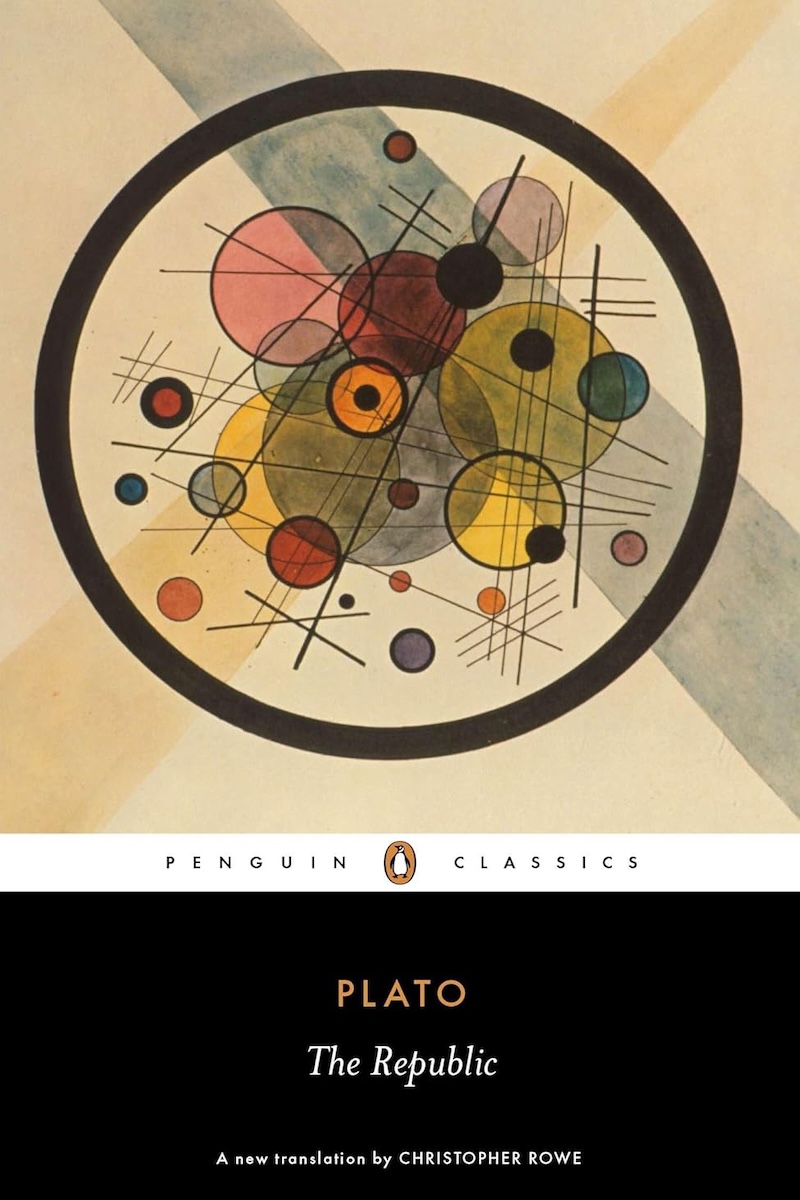
01 / Classic Textbook Recommendation
Classic Textbook Recommendation
Citation
Plato. (2007). The Republic (D. Lee, Trans.). Penguin Classics. (Original work published c. 380 BCE).
Intellectual & Historical Context
The Republic is a Socratic dialogue written by Plato around 380 BCE, representing one of the most influential works in Western philosophy and political theory. Written during a period of political turmoil in Athens following the Peloponnesian War and the execution of Socrates, the dialogue reflects Plato's disillusionment with Athenian democracy and his search for a more stable and just form of government.
The work emerged from Plato's Academy, the first institution of higher learning in the Western world, and synthesizes various philosophical traditions including Pythagorean mathematics, Heraclitean flux theory, and Socratic method. The dialogue format allows Plato to explore complex ideas through the voice of his mentor Socrates, examining questions that remain central to political philosophy today.
Thesis Statement
Plato argues that justice in the state mirrors justice in the individual soul, and that the ideal state must be ruled by philosopher-kings who possess both wisdom and virtue. Through the allegory of the divided line and the famous cave allegory, he presents a theory of knowledge that grounds political authority in philosophical understanding of eternal Forms, particularly the Form of the Good.
Key Concepts
The Tripartite Soul
Plato divides the human soul into three parts: reason (logos), spirit (thumos), and appetite (epithumia). Justice in the individual occurs when reason rules over spirit and appetite, creating harmony within the soul.
The Ideal State Structure
The republic consists of three classes corresponding to the soul's parts: guardians (rulers), auxiliaries (warriors), and producers (craftsmen and farmers). Each class performs its proper function without interfering with others.
The Theory of Forms
Plato posits a realm of eternal, unchanging Forms or Ideas that exist beyond the material world. True knowledge comes from understanding these Forms, particularly the Form of the Good.
The Philosopher-King
Ideal rulers must be philosophers who have knowledge of the Good and can apply this understanding to governance. They undergo extensive education in mathematics, dialectic, and practical experience.
The Noble Lie
Plato introduces the concept of a "noble lie" or founding myth to maintain social order and justify the class structure, raising questions about the relationship between truth and political stability.
Justice as Harmony
Justice is defined not as equality or fairness in the modern sense, but as each part of society performing its proper function in harmony with the whole.
Chapter Summaries
Book I: The Question of Justice
Socrates engages with Thrasymachus, who argues that justice is merely the advantage of the stronger. Socrates refutes this position, establishing that rulers should govern for the benefit of the ruled.
Book II: The Origin of the State
Glaucon and Adeimantus challenge Socrates to prove that justice is valuable for its own sake. Socrates begins constructing an ideal state from first principles, starting with basic human needs.
Book III: Education and the Guardians
Discussion of the education system for guardians, including censorship of poetry and music to shape moral character. Introduction of the "noble lie" to maintain social cohesion.
Book IV: Justice in State and Individual
Definition of the four cardinal virtues: wisdom, courage, temperance, and justice. Justice emerges as each part performing its proper function without interfering with others.
Book V: Women, Children, and Warfare
Radical proposals including equality of women as guardians, communal child-rearing, and the abolition of private property for guardians. Introduction of the philosopher-king concept.
Book VI: The Philosopher and the Good
Elaboration on why philosophers should rule, including the divided line analogy explaining different levels of knowledge from imagination to understanding.
Book VII: The Allegory of the Cave
Plato's famous allegory depicting prisoners mistaking shadows for reality, representing the philosopher's journey from ignorance to knowledge and the obligation to return and educate others.
Book VIII: The Decline of States
Analysis of how the ideal state degenerates through timocracy, oligarchy, democracy, and finally tyranny, with each form corresponding to a type of individual soul.
Book IX: The Tyrant and Happiness
Comparison of the just and unjust lives, demonstrating that the philosopher is happiest while the tyrant is most miserable, regardless of external appearances.
Book X: Poetry and Immortality
Critique of mimetic poetry as twice removed from reality. The myth of Er presents a vision of the afterlife and the immortality of the soul.
Key Quotes
The society we have described can never grow into a reality or see the light of day, and there will be no end to the troubles of states, or indeed, my dear Glaucon, of humanity itself, till philosophers become rulers in this world, or till those we now call kings and rulers really and truly become philosophers.
This quote encapsulates Plato's central political proposal: the union of political power and philosophical wisdom.
We can easily forgive a child who is afraid of the dark; the real tragedy of life is when men are afraid of the light.
This metaphor relates to the cave allegory, suggesting that people resist enlightenment and prefer familiar illusions.
The beginning is the most important part of the work.
Emphasizing the crucial role of education and early formation in creating just individuals and societies.
Significance & Impact
The Republic has profoundly influenced Western political thought for over two millennia. Its impact extends across multiple domains:
Political Philosophy: The work established fundamental questions about justice, legitimacy, and the purpose of government that continue to frame political discourse. Its critique of democracy and vision of expert rule resonates in contemporary debates about technocracy and populism.
Educational Theory: Plato's comprehensive educational program influenced liberal arts curricula and the concept of education as character formation rather than mere knowledge transmission.
Utopian Thought: The Republic served as a template for subsequent utopian literature, from Thomas More's Utopia to modern science fiction, while also inspiring dystopian critiques like Karl Popper's The Open Society and Its Enemies.
Metaphysics and Epistemology: The Theory of Forms shaped medieval philosophy through Neoplatonism and continues to influence debates about universals and the nature of reality.
Critical Analysis
Strengths
Plato's systematic approach to political philosophy, grounding government in a comprehensive theory of human nature and knowledge, provides a coherent framework for understanding political life. His emphasis on education and moral development offers valuable insights into civic formation. The dialogue format allows for nuanced exploration of complex ideas and acknowledgment of objections.
Controversies
The Republic's anti-democratic elements, including censorship, noble lies, and rigid class structure, have attracted criticism from liberal thinkers. The abolition of family for guardians and communal child-rearing strike many as totalitarian. Karl Popper famously accused Plato of promoting a closed society hostile to individual freedom.
Feminist Readings
While Plato's inclusion of women as potential guardians was revolutionary for its time, feminist scholars note that this equality is limited to the guardian class and premised on women becoming like men rather than valuing feminine perspectives.
Contemporary Relevance
The Republic's concerns about the relationship between truth and politics, the danger of demagogues, and the tension between expertise and democracy remain acutely relevant. Its exploration of how political systems shape individual character speaks to current discussions about civic virtue and social media's impact on democracy.
Real-World Applications
Meritocracy and Civil Service
The concept of selecting rulers based on wisdom and virtue influenced the development of meritocratic ideals and professional civil service systems, particularly through Confucian adoption in East Asia.
Educational Philosophy
The Republic's emphasis on holistic education shaped liberal arts traditions and continues to influence debates about curriculum, character education, and the purpose of schooling.
Constitutional Design
While no state has implemented Plato's exact blueprint, his analysis of regime types and constitutional degeneration informed later work on mixed constitutions and separation of powers.
Philosophical Counseling
The Republic's integration of personal ethics and political life provides resources for understanding how social structures affect individual wellbeing, relevant to contemporary discussions about mental health and social justice.
Modern Interpretations
Leo Strauss read the Republic as an ironic work demonstrating the impossibility of perfect justice, teaching the limits of political life rather than proposing a genuine political program.
Martha Nussbaum draws on Plato's emphasis on education and human development while critiquing his suppression of emotions and particular attachments.
Jacques Derrida examined the Republic's "pharmacy" of writing, exploring tensions between Plato's written critique of writing and his literary artistry.
Julia Annas interprets the Republic primarily as a work of ethics using political metaphors, rather than a literal political proposal.
Conclusion
The Republic remains essential reading for anyone seeking to understand the foundations of Western political thought. While many of its specific proposals may seem alien or troubling to modern sensibilities, its fundamental questions about justice, knowledge, education, and the good life continue to challenge and inspire. The work's enduring value lies not in providing final answers but in demonstrating how philosophical inquiry can illuminate the deepest problems of political life.
Whether read as a sincere political proposal, an elaborate thought experiment, or an ironic critique of utopianism, The Republic compels readers to examine their assumptions about human nature, social order, and the possibility of justice. In an era of democratic crisis and technological disruption, Plato's ancient dialogue offers both warnings about political degeneration and hope for the role of wisdom in public life.