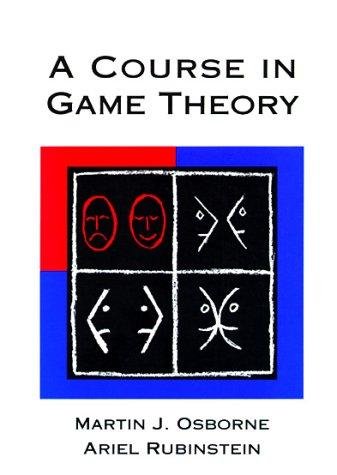
01 / Classic Textbook Recommendation
Classic Textbook Recommendation
Who this book is for
First-year graduate students in economics, advanced undergraduates in mathematics or economics who want a proof-based treatment, and researchers in political science, computer science or philosophy who need a careful account of the standard concepts. It suits readers who prefer a short, demanding book over a long applied one and are willing to work through exercises.
Prerequisites
Mathematical maturity at the level of a rigorous intermediate microeconomics or real analysis course; no prior game theory is required.
What it covers
The book is arranged in four parts. Strategic games cover Nash equilibrium, mixed strategies, correlated equilibrium, rationalizability and knowledge. Extensive games with perfect information treat subgame perfection, bargaining and repeated games. Extensive games with imperfect information introduce sequential and perfect Bayesian equilibrium and refinements. Coalitional games cover the core, stable sets, the Shapley value and the Nash bargaining solution, with a mathematical appendix.
How to use it
Read slowly, reconstructing proofs and working the exercises, which are integral to the text. The authors maintain an online version and solutions to selected problems. Pair it with a more applied text if you need economic examples, and return to the interpretive discussions after seeing the concepts used elsewhere.
Edition and sources
Single edition, published by The MIT Press in 1994 in hardcover and paperback; the paperback ISBN is recorded here, and the authors also make an electronic version available. Bibliographic data comes from Penguin Random House, the distributor's catalog.