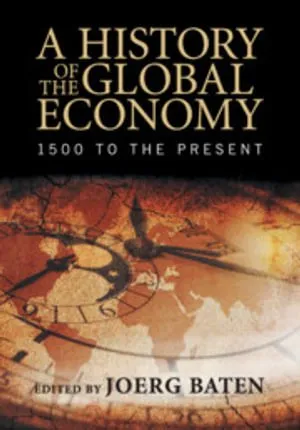
01 / Classic Textbook Recommendation
Classic Textbook Recommendation
Who this book is for
Undergraduates in economic history, economics, history and development studies who need a global, comparative account of long-run economic development. It suits courses on economic history and political economy that ask why prosperity diverged across regions, and students who want an introduction to recent quantitative research, including anthropometric and institutional evidence, beyond the European story.
Prerequisites
No prior economic history is needed; familiarity with basic economic concepts such as GDP, productivity and trade is helpful.
What it covers
Regional chapters cover north-western Europe; southern, eastern and central Europe; the United States and Canada; Latin America; Japan; China; the Middle East, North Africa and Central Asia; South Asia; South-East Asia with Australia and New Zealand; and sub-Saharan Africa. Interlinking chapters examine the great divergence in real incomes, human capital, the Great Depression and the post-2008 crisis, the natural resource curse, trade and poverty before 1913, women in economic history, stature as a health indicator, and institutional development.
How to use it
Use it as an alternative to Neal and Cameron: rather than one continuous narrative, it gives region-by-region chapters by specialists and draws more on recent quantitative evidence. Read the introduction first, then the regions your course compares, and use the interlinking chapters to frame comparative essays.
Edition and sources
This record describes the first and so far only edition, published by Cambridge University Press in paperback in 2016, with a hardback issued at the same time. Bibliographic data comes from Booktopia.