01 / Classic Textbook Recommendation
Classic Textbook Recommendation
Citation
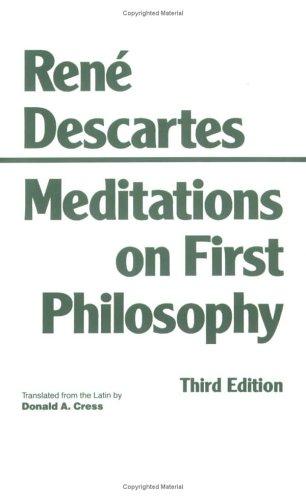
Descartes, R. (1993). Meditations on First Philosophy (D. A. Cress, Trans.). Hackett Publishing Company.
Why It Matters
Philosophy becomes an active practice in the Meditations: the reader is asked to suspend inherited certainty and rebuild knowledge step by step. The text introduces problems that still organize epistemology, metaphysics, philosophy of mind, and the philosophy of science.
Core Ideas
Methodic Doubt
Descartes tests beliefs by imagining increasingly powerful reasons for doubt. The point is not permanent skepticism, but a search for a foundation that survives the test.
The Cogito
The act of doubting reveals a thinker engaged in that act. The argument makes first-person awareness central to the project of grounding knowledge.
Mind and Body
The text distinguishes thinking from extended matter and asks how these different kinds of thing can be known and related. The problem remains influential far beyond Cartesian dualism.
Reason and Dependence
The argument moves between what the mind can establish on its own and what depends on a non-deceptive source. Following those transitions is essential to evaluating the whole system.
Reading Lens
Treat each meditation as a staged experiment. Mark the belief under examination, the reason for doubt, the temporary conclusion, and the new premise introduced in the next step.
Conclusion
Meditations on First Philosophy is not simply a set of famous quotations. It is a carefully sequenced argument about certainty, subjectivity, and the costs of trying to begin philosophy from first principles.