01 / Reading Guide
Reading Guide
Choose a mechanics text and justify your model before calculating
Compare algebra-based, intermediate and analytical mechanics texts, follow six study outputs, and check a worked spring-and-friction model.
Study route and exercise: University Reading List editorial project.
Who this book is for
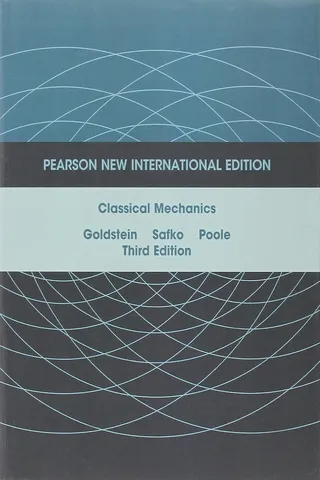
For physics and engineering students taking analytical mechanics after an introductory mechanics course. The book is useful when vector force calculations are familiar but generalized coordinates, constraints and symmetry still seem disconnected. Its progression offers a way to understand why alternative formulations of mechanics describe the same physical system and why some formulations are more effective for a particular question.
Prerequisites
University calculus, differential equations, vectors and introductory Newtonian mechanics. Review partial derivatives and ordinary differential equations before beginning the calculus of variations.
What it covers
Oscillations and nonlinear systems prepare for variational calculus, Lagrangian and Hamiltonian mechanics, symmetries and action principles. Applications extend to central forces, rotating frames, rigid bodies, coupled systems and continuous systems. More advanced sections connect classical formulations with relativistic and quantum ideas.
How to use it
Describe the physical degrees of freedom before choosing coordinates. Solve one small system with both force equations and a Lagrangian, checking that the resulting motions agree. State which constraints and symmetries you used, then identify a conserved quantity and test its dimensions. For a new variational derivation, write out the boundary assumptions rather than relying on the final formula. Use problems to compare the convenience and limitations of each formulation.
Edition and sources
The Rochester repository supplies the complete 2021 third edition, version 3.0, under CC BY-NC-SA 4.0. Ebook PDF ISBN 9780998837239 identifies this version. Repository deposit and later web-update dates are separate from the book edition.