01 / Classic Textbook Recommendation
Classic Textbook Recommendation
Citation
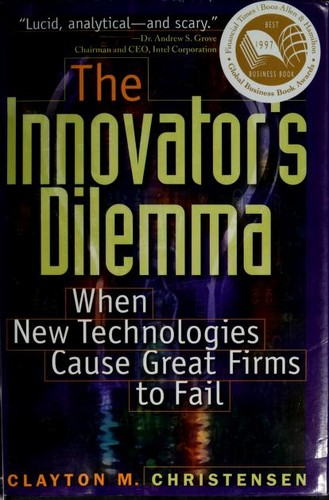
Christensen, C. M. (1997). The Innovator's Dilemma: When New Technologies Cause Great Firms to Fail. Harvard Business School Press.
Why It Matters
The business collection has substantial coverage of accounting, derivatives, fixed income, and risk, but little on strategy and innovation. Christensen explains why listening to existing customers and allocating resources rationally can still push a successful firm toward failure.
Core Ideas
Sustaining and Disruptive Innovation
Sustaining innovations improve products along dimensions valued by established customers. Disruptive innovations often begin with simpler, cheaper, or less profitable offerings before redefining the market.
Resource Allocation
Managers fund projects that fit current customers, margins, capabilities, and planning systems. Those choices can be sensible in the short run while starving a future market.
Value Networks
A firm's technology and organization are shaped by the customers, suppliers, and economics of its value network. Moving into a new network can require different measures of success.
Organizational Separation
New businesses may need autonomy to develop different processes and priorities. The challenge is to preserve useful capabilities without forcing every opportunity through the logic of the existing business.
Reading Lens
For a contemporary industry, identify the established performance metric, the overlooked customer, the entrant's initial market, and the moment when the basis of competition changes.
Conclusion
The Innovator's Dilemma is a strategy text about structural incentives rather than heroic leadership. It helps readers see how rational decisions can accumulate into strategic vulnerability.