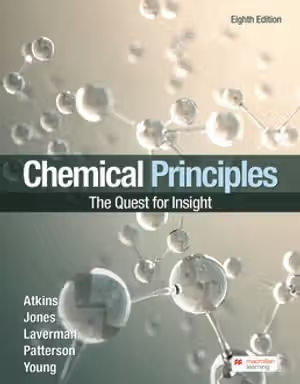
Chemistry 2e
Paul Flowers; Klaus Theopold; Richard Langley; William R. Robinson
69 selected books, grouped by course
Compare three books with short trial tasks, follow a six-step reading route, and test your reasoning with worked examples and changed assumptions.
Compare three chemistry texts, build a six-stage study route, and check an original limiting-reactant problem with explicit assumptions.
ChemistryOrganic ChemistryCompare biological, free survey and mechanism-led texts, then test proton-transfer reasoning with two original equilibrium problems and explicit checks.
ChemistryPhysical ChemistryCompare thermodynamics texts and derive ideal-gas conversion at fixed pressure and volume, with dimensionless activities and explicit minimum criteria.
A place to start
Suggested reading compiled by this site for university students and independent learners. This is not an official university reading plan. Check your own syllabus before buying; editions and exercise numbers differ.
Browse all books ↓Start with the course you are actually taking: general, organic, analytical, inorganic or physical chemistry. These books are not interchangeable. Check whether your course assumes calculus, physics or prior chemistry, and use its assigned edition when chapter numbers matter.
Books are grouped by the course they are usually read for, then ordered from introductory to advanced.
Study guides: General chemistry: connect particles, equations and quantities →
Study guides: Organic chemistry: choose a route from electron movement to equilibrium →
Study guides: Physical chemistry: equilibrium depends on the imposed constraint →