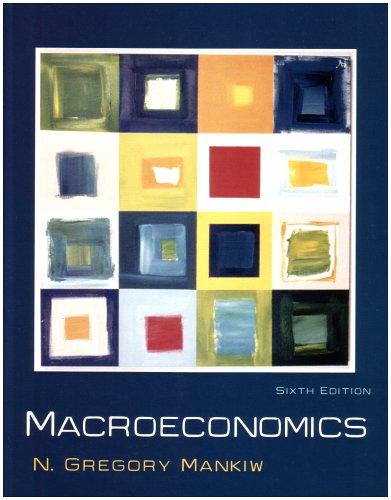
01 / Classic Textbook Recommendation
Classic Textbook Recommendation
Citation
Mankiw, N. G. (2006). Macroeconomics (6th ed.). Worth Publishers.
Why It Matters
The existing economics collection is strong in quantitative finance but thin on the core language used to describe whole economies. Mankiw's text supplies that missing foundation by connecting national accounts, models, policy debates, and lived economic outcomes.
Core Ideas
Measuring the Economy
GDP, inflation, unemployment, and productivity are imperfect measures, but they provide a common vocabulary for discussing economic change. The book emphasizes what each indicator includes and what it hides.
Long-Run Growth
Capital accumulation, population, technology, and institutions shape living standards over decades. Growth theory turns large historical differences into questions that can be analyzed.
Short-Run Fluctuations
Economies do not move smoothly. Aggregate demand, expectations, sticky prices, and financial conditions help explain recessions and recoveries.
Policy and Trade-offs
Monetary and fiscal policy can stabilize activity, but interventions have limits, delays, and distributional consequences. Macroeconomic reasoning therefore requires both models and institutional context.
Reading Lens
For each model, write down the time horizon, the agents, the market frictions, and the policy variable. Then ask which empirical fact the model clarifies and which facts it leaves outside the frame.
Conclusion
Macroeconomics is a useful foundation for reading economic news and advanced theory. It gives the finance-heavy collection a clearer connection to growth, employment, inflation, and public policy.