01 / Classic Textbook Recommendation
Classic Textbook Recommendation
Citation
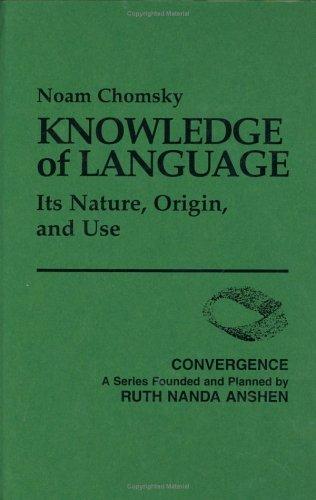
Chomsky, N. (1986). Knowledge of Language: Its Nature, Origin, and Use. Praeger.
Why It Matters
Chomsky distinguishes the knowledge that allows speakers to produce and understand novel sentences from the habits observed in particular conversations. The book asks what a scientific theory of linguistic competence should explain.
Core Ideas
Competence and Performance
A speaker can recognize and create sentences they have never encountered. Linguistic theory therefore studies the underlying system, not only recorded behavior.
Structure and Rules
Grammar is not a list of memorized sentences. It is a structured set of principles that generates an unbounded range of expressions.
Acquisition
Children acquire complex linguistic knowledge quickly and with limited direct instruction. This raises questions about the interaction between innate capacities, experience, and social input.
Explanatory Levels
A theory must connect abstract structure to sound, meaning, and use without confusing those levels. Chomsky uses this distinction to argue for a particular conception of linguistic science.
Reading Lens
Separate the empirical observations, the proposed formal mechanisms, and the philosophical claims about explanation. Compare the book with usage-based, functional, and sociolinguistic approaches to language.
Conclusion
Knowledge of Language is a demanding but influential statement of generative linguistics. It is useful even for readers who disagree with its conclusions because it makes the assumptions of a linguistic theory explicit.